
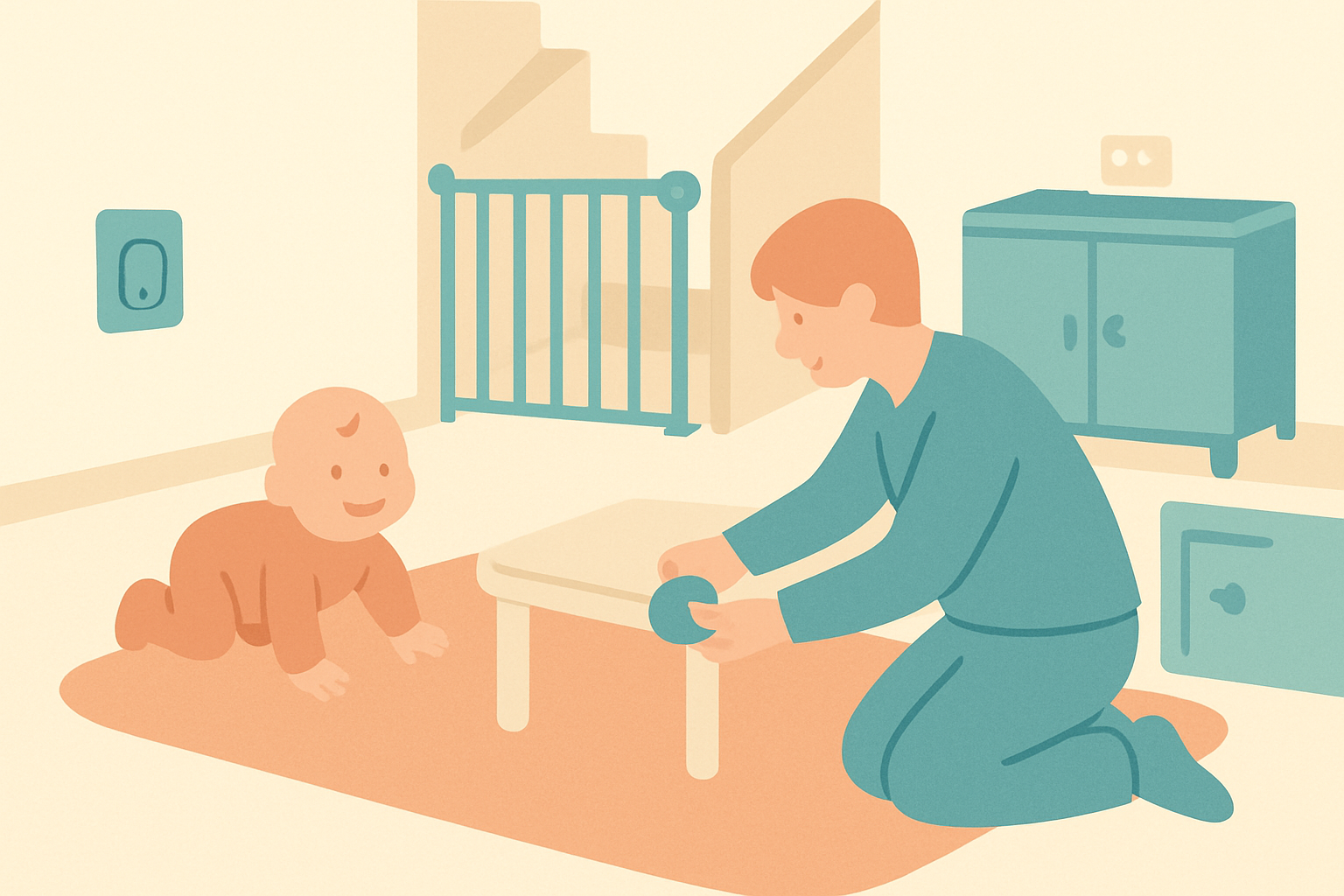
There is a specific moment most parents remember. You set your baby down on the rug, turn around to grab a glass of water, and when you look back they are three feet from where you left them, reaching for a lamp cord with real determination. Nothing bad happens. But something shifts, and suddenly your living room looks completely different to you.
That is usually when the search for a baby proofing checklist begins, and it can feel overwhelming fast. Search around and you will find lists with two hundred items, half of which involve buying something. The good news is that a small number of changes handle most of the serious risk, and the rest can be done gradually as your baby's skills change.
This guide walks through when many parents start, which fixes matter most, and what to look at in each room. Every home is different and every baby is different, so treat this as a starting point rather than a rulebook. Your pediatrician is a great person to ask about anything specific to your baby or your living situation.

You do not have to do it all in one weekend. Handle the big four first, then chip away at the rest.
When to Start Baby Proofing
Many parents find that somewhere around four to six months is a comfortable time to begin. That may sound early when your baby is still mostly staying where you put them, but mobility tends to arrive suddenly rather than gradually. A baby who has been rolling in one direction for weeks can be scooting across a room within days, and the middle of that transition is a stressful time to be shopping for stair gates.
The other reason to start early is simply energy. Baby proofing takes an afternoon or two of drilling, sorting, and moving things around, and that is far easier to do while your baby still naps predictably than once they are cruising along the furniture. Some parents find it helpful to start right around the time their baby begins sitting up independently, since that often signals the run up to crawling.
If your baby is already mobile and you have not started, that is completely fine and very common. Start with the highest risk items rather than trying to do everything, and give yourself permission to do the rest over a few weeks. Progress here counts for a lot more than perfection.
The Four Fixes That Matter Most
If you only have one afternoon, spend it on these. They address the hazards that lead to the most serious injuries in young children, and they are the ones safety organizations consistently put at the top of the list.
Anchor furniture and televisions
Dressers, bookcases, shelving units, and freestanding televisions can tip over when a baby pulls up on them or opens a drawer to use as a step. Anti tip straps and brackets are inexpensive and most new furniture includes them in the box. It is worth going around the whole house rather than just the nursery, since the living room television stand and the hallway bookcase are just as reachable to a determined baby.
While you are at it, consider what is sitting on top of furniture. A remote control, a phone, or a bowl of keys on a dresser gives a baby a reason to climb, so moving those items lower removes the temptation entirely.
Lock away medicines, cleaning products, and small batteries
This means everything, not just the obvious bottles under the sink. Vitamins, diaper cream, hand sanitizer, laundry pods, essential oils, and any purse or bag with medication in it all belong somewhere a baby cannot reach. Button batteries deserve special mention because they are found in remotes, greeting cards, thermometers, and small toys, and swallowing one is a medical emergency. Store spares in a locked place and check that battery compartments on household items are screwed shut.
Many parents find it easier to relocate these items to a high shelf than to install latches on every low cabinet. Height is a simpler and more reliable barrier than any latch, especially in the early stages.
Gate the stairs
If you have stairs, gates at both the top and the bottom are the general guidance. The gate at the top should be hardware mounted, meaning it screws into the wall or banister, because pressure mounted gates rely on tension and can shift under weight. Pressure mounted gates are usually fine at the bottom of stairs or in a doorway where a fall is not the risk.
Deal with window cords and windows
Corded blinds are a strangulation hazard, and the safest fix is replacing them with cordless versions in any room your baby spends time in. If replacement is not practical right now, cord cleats mounted high on the wall keep cords wound up and out of reach. Separately, window screens are designed to keep bugs out and will not hold a child's weight, so window guards or stops that limit how far a window opens are worth considering for upper floors.
| Priority | What to do | Rough effort |
|---|---|---|
| Do first | Anchor furniture and TVs to the wall | 1 to 2 hours, drill needed |
| Do first | Move medicines, cleaners, and batteries up high or lock them | 1 hour, no tools |
| Do first | Install hardware mounted gate at the top of stairs | 30 to 60 minutes, drill needed |
| Do first | Replace or secure corded window blinds | Varies, sometimes a purchase |
| Do next | Outlet covers and cord management | 30 minutes, no tools |
| Do next | Cabinet and drawer latches in kitchen and bathroom | 1 to 2 hours |
| Do next | Corner guards on low tables and hearths | 20 minutes |
| Do later | Door pinch guards, doorknob covers, toilet locks | As needed once walking |
A rough sequencing guide many parents find useful. Homes vary a lot, so adjust based on your layout and how your baby is moving.
Room by Room Checklist
Living room
This is where most babies spend their floor time, so it usually gets the most attention. Look at the coffee table and any hearth or fireplace surround for sharp corners at head height, and consider soft guards or simply moving the table out during the crawling months. Television and lamp cords are a favorite target, so cord covers or routing them behind furniture helps. Check that floor lamps are stable, that houseplants are out of reach, and that any decorative bowls holding coins or small objects are moved up.
Fireplaces deserve a second look even when they are not in use, since the hearth is often stone and sits at exactly the height a pulling up baby will meet it. A gate around the fireplace area is a common solution for families who use theirs regularly.
Kitchen
The kitchen has more hazards per square foot than anywhere else, which is why some families simply gate it off during cooking. If that is not practical, focus on the under sink cabinet, the knife drawer, and the oven. Stove knob covers stop a curious toddler from turning on a burner, and turning pot handles inward is a small habit that prevents a lot. Trash cans are worth a thought too, since they tend to hold exactly the things you would not want a baby handling.
Many parents find it helps to designate one low cabinet as the baby cabinet, filled with plastic containers and wooden spoons. Having somewhere they are allowed to open takes a surprising amount of pressure off all the places they are not.
Bathroom
Water is the main concern here. Even a small amount in a tub or bucket is a drowning risk for a baby, so emptying containers right away matters more than any gadget. Keep the bathroom door closed when it is not in use, consider a toilet lock, and check your water heater setting, since many pediatricians suggest keeping it at or below 120 degrees Fahrenheit to reduce scald risk. Medicine cabinets and grooming items like razors and nail scissors should be well above reach.
Nursery and bedrooms
The crib itself should be free of pillows, bumpers, and loose blankets, which lines up with the broader safe sleep guidelines most pediatricians follow. Once your baby can pull to standing, lower the crib mattress to its lowest setting and remove any mobile or hanging toy they could reach. Check that the crib is not next to a window with cords or curtains, and that the changing table is anchored if it is a dresser style piece.
What Changes as Your Baby Grows
Baby proofing is not a one time project, which is the part nobody warns you about. Each new skill unlocks a new set of things to look at, so it helps to revisit your home every couple of months rather than assuming you are done.
Around the time babies start crawling, floor level hazards become the focus: cords, small objects, pet bowls, and doorstops with removable rubber tips. When pulling up begins, the danger zone rises to about waist height, which is when furniture anchoring and coffee table corners suddenly matter. Once your baby is walking and climbing, you are looking at counters, chairs used as ladders, and door handles.
Some babies may skip stages or move through them very quickly, and every baby is different in what they find interesting. The child who ignores the outlet entirely might be fascinated by the toilet, so the most useful approach is watching your own baby and responding to what they are actually drawn to.

Note the day your baby first pulls to standing. That is your cue to sweep the house again at a higher level.
The Floor Test
The single most useful thing you can do costs nothing. Get down on your hands and knees in each room and crawl around at your baby's eye level, slowly, looking at everything the way they would. It feels a little silly and it works better than any checklist, because you will spot things specific to your home that no article could predict.
You will notice the gap behind the couch where a phone charger dangles, the loose bit of baseboard, the dog's water bowl, the wobbly plant stand, the tiny screw under the radiator. Parents who do this almost always come away with a handful of items they never would have thought of, and the list tends to be much shorter and more actionable than a generic checklist of two hundred things.
It is worth repeating the floor test every couple of months, and especially after any change to your home such as new furniture, a holiday decoration, or a move. Small objects that could be a choking hazard are the most common find, and a good rule of thumb is that anything that fits through a toilet paper tube is too small to leave within reach.
Where Parents Tend to Overdo It
It is easy to spend a lot of money on baby proofing products that solve problems you do not have. Plug in outlet caps, for example, are widely sold but the small ones can become a choking hazard themselves if a baby pries one out, so sliding outlet covers or full plate replacements are often the better choice. Similarly, corner guards on every surface in the house can be more trouble than they are worth, since some falls and bumps are simply part of learning to move.
The other thing worth saying is that baby proofing does not replace supervision, and no amount of equipment will. Most parents land somewhere in the middle: a home where the serious risks are handled so that the ordinary five second gaps of daily life are not frightening, combined with staying reasonably close while your baby explores. That balance lets you relax a little, which is much of the point.
If you want a second opinion on your home, some pediatric offices have safety handouts specific to your area, and your pediatrician is used to this question at the six and nine month visits. Bringing it up at a checkup is an easy way to get advice tailored to your baby and your setup.
Track the Milestones That Change Your Checklist
Pippy lets you log the moment your baby first rolls, crawls, pulls up, or takes a step, so you always know when it is time to sweep the house again at a new height. It is also an easy way to have exact dates ready when your pediatrician asks how mobile your baby has become.
Try Pippy Free