
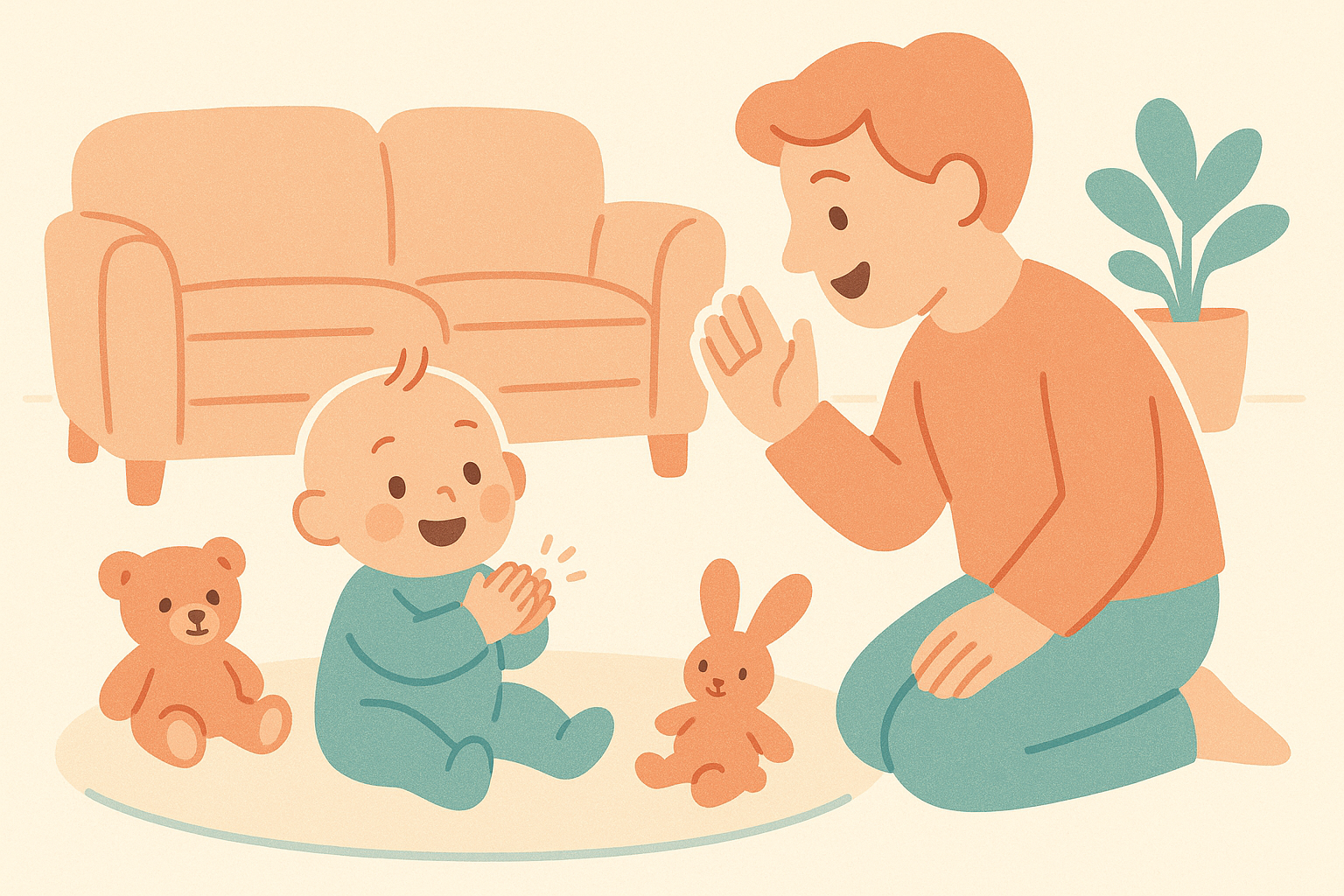
There is a particular kind of delight in the first time your baby claps. One second they are just sitting there watching you sing, and the next their hands come together, mostly by accident, and their whole face lights up because they realize they did that. The same goes for the first wobbly wave at grandma on a video call. These little gestures feel like the first real conversation you have had.
If you are wondering when babies clap and wave, the honest answer is that the window is wide. Many babies clap somewhere between 8 and 12 months and wave somewhere between 9 and 12 months, but plenty of perfectly healthy babies land outside those ranges in both directions. A baby who is pouring all their energy into pulling up and cruising may not have much left over for hand tricks, and that is normal.
Here is how these gestures usually develop, what they actually tell you about your baby, and the low pressure things many parents find helpful for encouraging them.
First gestures rarely show up on schedule, and that is part of the fun. Celebrate the messy early attempts, because those count too.
What Counts as a Gesture Milestone
A gesture is any movement your baby uses on purpose to communicate something. Clapping, waving, pointing, reaching up to be held, shaking their head, and giving you a high five all belong in the same family. What ties them together is intention. Your baby is not just moving their body, they are trying to get something across to you.
This is why pediatricians pay attention to gestures at the 9 month and 12 month checkups. Gestures sit right at the intersection of motor skills and social communication, so they tell you two things at once. Your baby needs enough coordination to bring their hands together or lift one arm, and enough social awareness to want to share a moment with another person. Speech is still months away for most babies at this stage, so gestures are the earliest reliable window into how they are learning to connect.
It also means gesture milestones tend to arrive in clusters rather than one at a time. Many parents notice that clapping, waving, babbling with more variety, and playing peekaboo all seem to show up within the same few weeks. If you have been following our baby babbling timeline, you may spot the overlap. The same developmental leap tends to power both.
When Do Babies Start Clapping?
Clapping most often appears between 8 and 12 months, with quite a few babies getting there closer to 15 months. Before a baby can clap, they usually need to be able to bring both hands to the middle of their body and coordinate them together, a skill that builds slowly across the first year. You may have already watched it developing when your baby started banging two toys together or transferring a rattle from one hand to the other around 6 to 8 months.
Early clapping rarely looks like applause. It is often two flat palms drifting together with almost no sound, or one hand tapping the back of the other. Some babies clap with their hands too far apart to actually connect and look thrilled anyway. All of this counts. The coordination for a crisp, rhythmic clap usually arrives a couple of months after the first attempts.
Most babies also clap for a reason, and that reason is almost always you. Clapping tends to emerge in moments of shared excitement, which is why it so often shows up during songs, at mealtimes, or when someone walks into the room. Some babies may clap to celebrate their own accomplishments, like getting a block into a cup. That social flavor is a big part of why the milestone matters.
When Do Babies Start Waving?
Waving typically shows up between 9 and 12 months, often a little after clapping, though some babies reverse the order entirely. Early waves come in many forms. Some babies open and close their whole hand, some swing an entire arm, some flap both hands at once, and some wave at their own hand rather than at you. Every baby is different, and the style tends to settle over time.
The trickier part of waving is timing. Understanding that a wave belongs at hello and goodbye takes longer than the physical motion does. It is extremely common for a baby to wave enthusiastically at a closed door thirty seconds after someone left, or to wave at the dog, the ceiling fan, and nobody in particular. That delayed, slightly random waving is a sign that your baby is working out the rule, not a sign that something is off.
Around the same time you may notice your baby waving in situations that feel connected to separation. Some babies wave when a parent puts on their shoes or picks up a bag. Many parents find this stage bittersweet, since it lines up with the period when babies are also becoming more aware of comings and goings in general.
Pointing, and Why It Matters So Much
Pointing usually arrives a bit later, often between 10 and 14 months, and it deserves its own mention because pediatricians consider it one of the more informative early gestures. It generally appears in two flavors. Some pointing is a request, as in "I want that cracker." Some pointing is purely for sharing, as in "look at that dog, are you seeing this?" That second kind, where your baby points and then checks your face to see if you are looking too, is a particularly meaningful sign of social communication.
Before a clear index finger point, many babies go through a whole hand reaching phase where they stretch an open palm toward what they want. That is a normal step along the way. The refined point with one finger takes more control and usually follows within a month or two.
The most useful thing you can do with pointing is respond to it. When your baby points, look where they are looking, name what you see, and say a little about it. Doing that dozens of times a day builds vocabulary long before your baby produces words. If you are curious about how those first words connect to gestures, our guide on baby milestones month by month lays out how the pieces fit together across the first year.
Gesture Timeline by Age
The ranges below are general guidance rather than deadlines. Babies born prematurely are often tracked using adjusted age, and any baby can be early with one gesture and later with another. What most pediatricians look at is the overall direction of travel rather than a single box that has not been checked yet.
| Age | Gestures many babies show | What it builds toward |
|---|---|---|
| 4 to 6 months | Reaching for objects, bringing hands together at the middle | The coordination clapping needs later |
| 6 to 8 months | Banging two toys together, passing objects hand to hand | Two hands working as a team |
| 8 to 10 months | First clapping attempts, arms up to be picked up | Using movement on purpose to communicate |
| 9 to 12 months | Waving, playing peekaboo, offering you a toy | Back and forth social exchange |
| 10 to 14 months | Pointing to request and to share, head shaking for no | Early vocabulary and joint attention |
| 12 to 18 months | Clapping on cue, waving hello and goodbye reliably, blowing kisses | Gestures paired with first words |
General ranges only, and every baby is different. Your pediatrician is the best source of guidance for your child. For more on nearby milestones, see our guide on when babies sit up.
Jot down the date of that first wave when it happens. Those little notes are surprisingly handy at checkup time.
Simple Ways to Encourage Gestures
Babies pick up gestures through repetition inside ordinary moments, not through practice sessions. The most effective approach is usually to do the gesture yourself, often, and always paired with the same word. Wave and say "bye bye" every single time someone leaves the room, even if it is just you heading to the kitchen. Clap and say "yay" when your baby finishes a bottle or knocks over a tower. Consistency matters more than enthusiasm here, though enthusiasm certainly does not hurt.
Songs do a lot of the work for you. Anything with a repeated hand motion, like patty cake or a clapping verse in a nursery rhyme, gives your baby a predictable cue plus a reason to join in. Many parents find that gently taking their baby's hands and clapping them together during the song helps things click, as long as it stays light and playful and stops the moment your baby seems done.
Mirrors, video calls with family, and games of peekaboo all give gestures a natural home too. So does simply narrating what you are doing throughout the day. And it is worth saying plainly that you do not need to teach any of this. Babies learn gestures from watching the people around them living normally. If you are having a week where you are barely holding it together, your baby is still learning.
Keep the first clap, wave, and point in one place
Pippy lets you log milestones the moment they happen, with a photo and a note, so the first wobbly wave does not get lost in your camera roll. When the 12 month checkup comes around, everything your pediatrician asks about is already written down.
Try Pippy FreeWhen to Talk to Your Pediatrician
Missing a single gesture on a single timeline is rarely meaningful on its own. What pediatricians tend to look at is the broader pattern of how a baby communicates, which includes eye contact, responding to their name, babbling with a range of sounds, sharing attention with you, and using gestures of any kind.
It is worth bringing up with your pediatrician if your baby is not using any gestures at all by around 12 months, is not pointing by around 15 to 18 months, does not respond to their name, has stopped doing something they used to do, or if babbling has gone quiet. Loss of a skill your baby had previously is the one worth calling about sooner rather than waiting for the next scheduled visit.
If any of that describes your situation, talk to your pediatrician rather than trying to work it out from an article. They can look at the whole picture, including how your baby moves, hears, and interacts, and they have the right screening tools. Early support is genuinely effective when it turns out to be needed, and reassurance is worth a lot when it turns out not to be. You can find more milestone guides on the Pippy blog or explore the tracker itself over at Pippy.