
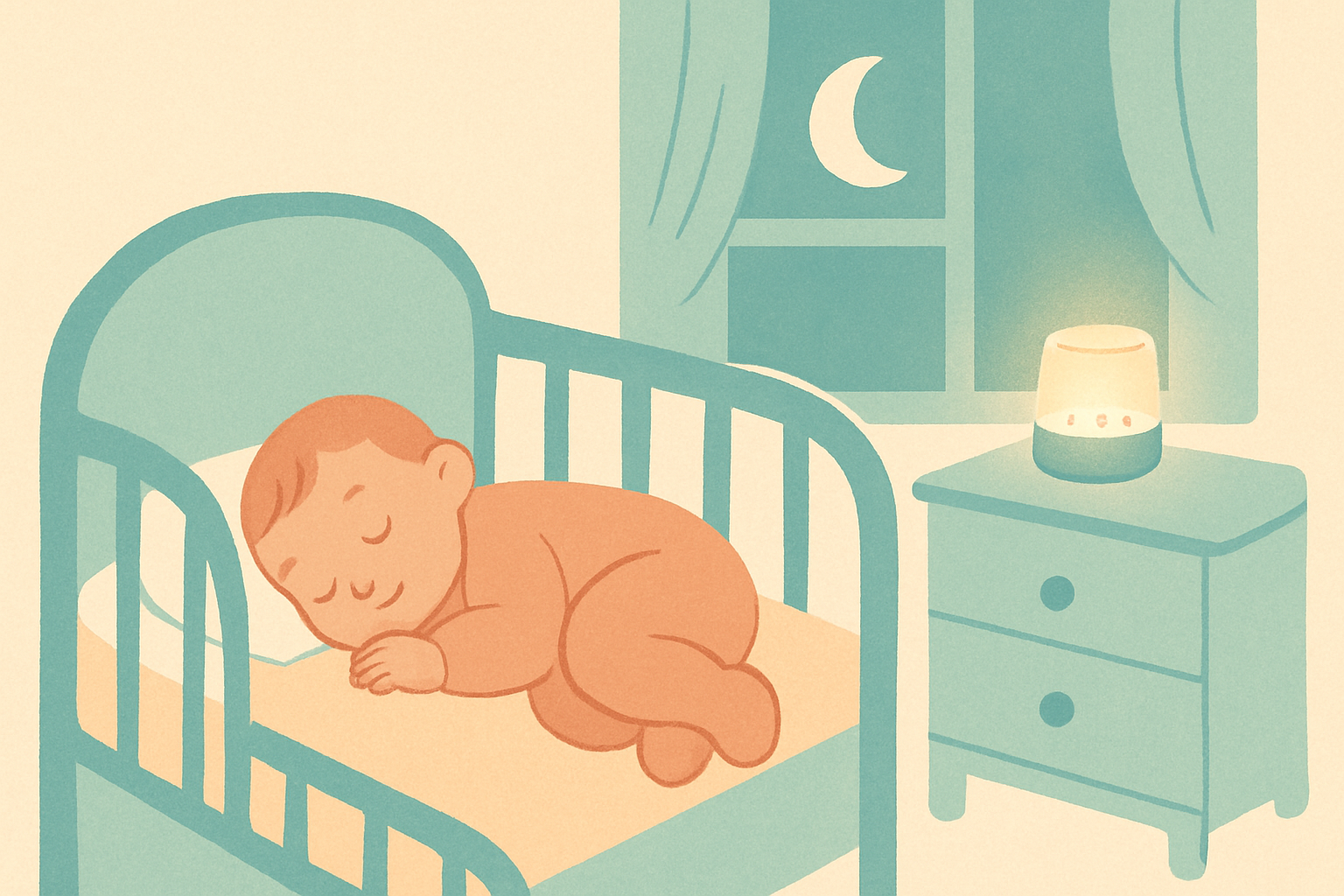
If you have ever tiptoed out of the nursery only to have a sneeze, a creaky floorboard, or the dog deciding to bark at nothing wake up your baby, you already understand why so many parents fall in love with white noise. A steady, gentle sound can smooth over all those little jolts that pull babies out of sleep, and many families find it makes naps and nights noticeably calmer.
At the same time, it is fair to wonder if running a sound machine every night is actually safe. Will it hurt your baby's hearing? Is there a right volume? Will your baby become forever dependent on it? These are common questions, and the good news is that white noise is generally considered a safe and helpful tool when it is used thoughtfully.
This guide walks through what white noise actually is, why it helps babies sleep, how loud is too loud, where to place the machine, and how to wean off it later if you want to. Every baby is different, so use this as a friendly starting point and adjust to what works for your family.

A sound machine is one of the easiest sleep tools to try. If it works for your baby, you will know within a night or two, and if it does not, you can always switch it off and try something else.
What Is White Noise, Exactly?
White noise is a steady, even sound made up of many frequencies played together at roughly the same level. To our ears it sounds like a soft, continuous hiss, similar to a fan, an air purifier, or rain on a roof. Because all the different frequencies are mixed together, white noise has a way of masking sudden changes in sound that would normally catch your attention.
For a baby who has spent nine months listening to the muffled rush of blood, heartbeat, and digestion inside the womb, the outside world can feel surprisingly quiet and exposed. Many parents find that a soft, continuous sound helps recreate some of that familiar comfort, especially in the early weeks. That is part of why so many newborns settle quickly to the hum of a hair dryer, a running shower, or a sound machine.
It is worth noting that not every sound marketed as white noise is technically white. Some machines play pink or brown noise, ocean waves, lullabies, or even heartbeat sounds. We will look at the differences a little later, but the main idea is the same. A steady, soothing background sound can help babies fall asleep and stay asleep through the small disruptions of daily life.
Why White Noise Helps Babies Sleep
Babies are wired to wake easily, which is part of how they keep themselves safe and signal that they need feeding, a diaper change, or a cuddle. That same sensitivity, though, can make it hard for them to stay asleep when a sibling slams a door or a delivery truck rumbles down the street. White noise gently fills in those gaps, so a sudden bang is less likely to register as a startle.
Many parents notice their baby falls asleep faster when a sound machine is on. Part of this is the calming effect of repetitive, predictable sound, and part of it is the strong association that builds over time between that hiss and sleep. Just like dimming the lights or zipping a sleep sack, white noise becomes a clear cue that says "it is time to rest." Pairing it with a consistent baby bedtime routine can make wind down even smoother.
White noise can also be especially helpful during fussy stretches, growth spurts, and the early days of helping a newborn sort out their day and night confusion. Some babies may even fall asleep more easily in their bassinet or crib when there is steady sound in the room, because the silence between rooms feels less jarring than they would if everything were quiet.
Is White Noise Safe for Babies?
The short answer is yes, when it is used at a safe volume and distance. White noise has been used in nurseries for decades, and most pediatric experts consider it a helpful tool, not a hazard. The concerns parents sometimes hear about usually come down to how loud the sound is and how close the machine sits to the baby's ear, both of which are easy to manage.
The most often cited research is a 2014 study that tested infant sound machines and found that many could exceed safe noise limits if turned all the way up and placed right next to the crib. That study did not say white noise is dangerous, only that it should be used at a moderate volume and a reasonable distance, the same way you would think about any sound around a baby. Used thoughtfully, a sound machine is widely considered safe for daily use.
If your baby has any diagnosed hearing concerns, recurring ear infections, or other health issues that affect their ears, talk to your pediatrician before adding a sound machine to the routine. They can give guidance that fits your baby specifically. For most healthy babies, though, white noise is one of the gentler sleep tools you can try.
How Loud and How Far Away
The two most important dials when using white noise are volume and distance. The general guidance shared by many pediatric and audiology groups is to keep the sound machine at least 7 feet (about 2 meters) away from the crib and at or below about 50 decibels at the baby's ear. Fifty decibels is roughly the volume of a quiet office or a soft shower heard from the next room.
You do not need professional equipment to check this. A free decibel meter app on your phone works well enough. Stand or kneel next to the side of the crib where your baby's head will rest, point the phone toward the sound machine, and adjust the volume until the reading sits around 50 or just under. If you cannot easily talk over the sound from across the room, it is probably too loud.
| Sound | Approximate Volume | How It Compares |
|---|---|---|
| Whisper | About 30 dB | Quieter than most nurseries at night |
| Quiet library or bedroom | About 40 dB | Good baseline for a sleeping baby |
| Recommended white noise | Up to about 50 dB | Calming, masks small sounds |
| Normal conversation | About 60 dB | Louder than recommended for naps |
| Vacuum cleaner | About 70 dB | Too loud for ongoing use near a baby |
Decibel ranges are approximate and vary by source. When in doubt, lower is better, and always position the machine across the room rather than right next to the crib.
How to Use a Sound Machine
Setting up white noise is simple, but a few small choices make a big difference. Place the machine on a dresser, shelf, or table on the opposite side of the room from the crib, not on the crib rail or just outside the bassinet. Aim the speaker away from your baby if possible, so the sound fills the room rather than blasting at one spot. Plug it in if you can, since batteries draining mid nap is a sad surprise.
Many parents like to turn the sound machine on as part of the wind down, a few minutes before laying baby down. The familiar hiss becomes part of the cue, along with dim lights, a clean diaper, and a sleep sack. If you are still working on your newborn sleep schedule, using the same sound for every nap and bedtime can help reinforce the rhythm a little faster.
You can leave the sound on for the entire sleep period or use a built in timer. Many parents prefer to leave it running, because waking up mid nap to total silence is often what triggers the next cry. Whichever way you go, follow your safe sleep guidelines, including a firm flat mattress and no extra items in the crib. The machine itself should sit somewhere baby cannot reach, with its cord well out of the way.

When you log naps and night sleep for a week, you will quickly see which sounds and volumes seem to settle your baby fastest. Patterns show up faster than memory ever could.
White, Pink, and Brown Noise
If you have ever scrolled through the sound options on a baby app or a sound machine, you have probably noticed they are not all called white noise. Pink noise, brown noise, fan sounds, ocean waves, and womb sounds are all common. The differences are mostly about which frequencies are loudest, which changes how the sound feels to the ear.
White noise has equal energy across all frequencies and sounds like a bright, even hiss. Pink noise has more low frequencies and less high pitched hiss, so it sounds softer and a bit deeper, similar to steady rain. Brown noise has even more low end, with a rumbly, almost roaring quality that some compare to a strong waterfall or distant thunder. Many babies seem to prefer pink or brown noise, especially as they get a little older, because the lower tones are easier on the ear.
There is no one right choice. Try a couple of options over a few nights and notice which one seems to help your baby settle the fastest and stay asleep the longest. Some babies prefer the same sound for every sleep, while others do well with a mix. Whatever you land on, keep it consistent within each sleep so the sound itself does not change suddenly partway through a nap.
Weaning Off White Noise
You do not have to stop using white noise at any particular age. Plenty of older children and adults sleep better with a fan or a sound machine running. If at some point you want to phase it out, the easiest method is a slow taper. Lower the volume by a small amount every few nights, so the change is barely noticeable, until the machine is just barely audible and then off entirely.
Many parents find that weaning is easier outside of big transitions. Trying to drop the sound machine during a baby sleep regression, a move, or right after starting daycare can make sleep feel even bumpier. Picking a calmer stretch, like a normal couple of weeks at home, tends to go more smoothly.
It is also fine to keep using it for as long as it helps. Sleep is precious for everyone in the house, and a sound machine that gives the whole family more rest is a tool worth keeping around. When you are ready to make a change, you can always revisit it then.
Track sleep, naps, and what works with Pippy
Pippy makes it easy to log naps, night sleep, wake ups, and the little tweaks you try, like a new sound or volume, so you can see what actually helps your baby sleep longer. Start tracking for free and let the patterns show themselves.
Try Pippy Free