
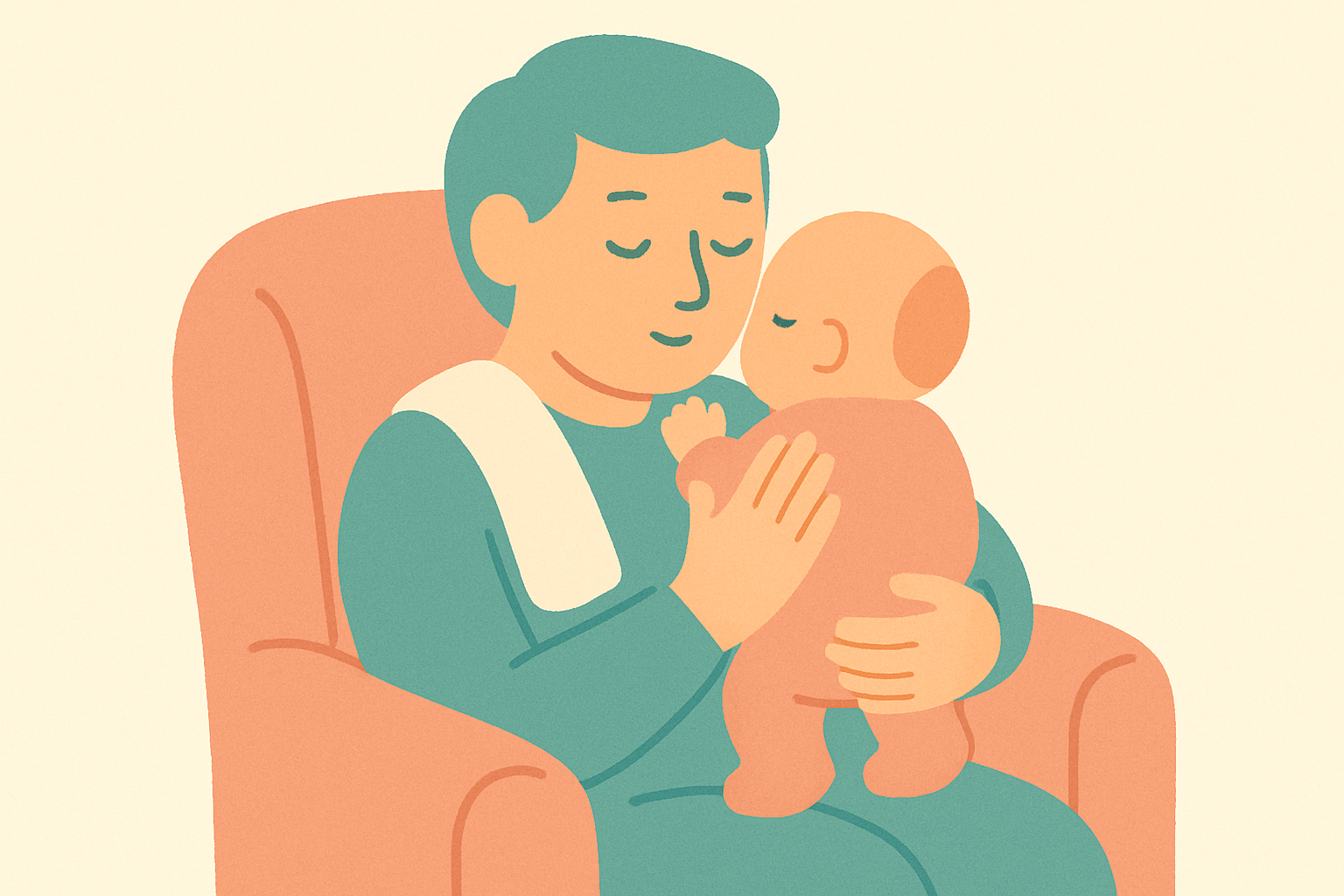
Nobody warns you that learning how to burp a baby feels a little like a party trick you were never taught. You finish a feed, lift your baby to your shoulder, pat away hopefully, and then stand there in the dark wondering how long you are supposed to keep doing this and whether anything is actually happening in there. It is one of those small newborn skills that looks effortless when someone else does it and mysteriously difficult at two in the morning.
The reassuring part is that burping is far more forgiving than it feels. There is no single correct technique, no minimum number of pats, and no rule that every feed must end in a dramatic belch. Babies swallow some air while they eat, especially from a bottle, and burping simply gives that air an easy way out. Some babies release it loudly and immediately. Some babies may take a few minutes. Some barely burp at all and are perfectly comfortable anyway.
Below are the three positions most parents rotate through, a simple sense of when to burp during a feed, and what to do on the nights when nothing comes up. Every baby is different, so treat all of this as a starting point rather than a checklist, and bring any worries about feeding or discomfort to your pediatrician.
- Why Babies Need Burping in the First Place
- Three Burping Positions to Try
- When to Burp During a Feed
- How Long to Burp and When to Stop
- What to Do When Your Baby Will Not Burp
- How to Help Your Baby Swallow Less Air
- When Babies Outgrow Burping
- Keeping Track of Feeds and Fussiness
- Frequently Asked Questions

There is no such thing as burping wrong. If your baby is upright, supported, and comfortable, you are already doing the important part.
Why Babies Need Burping in the First Place
When a baby feeds, milk is not the only thing going down. Small amounts of air get swallowed along the way, particularly when a baby is gulping quickly, crying before a feed, or drinking from a bottle where the nipple is not completely full of milk. That air collects in the stomach, takes up room that milk would otherwise fill, and can leave a baby feeling full before they have actually eaten enough.
Burping gives that air a route back out. When it works, a baby often settles, and sometimes happily takes a bit more milk afterward. Many parents notice that a baby who seemed squirmy and unfinished suddenly relaxes once a burp arrives, which is the whole reason the habit stuck around.
It is worth saying clearly that trapped air is not dangerous, and a missed burp is not a problem you need to fix. Air that does not come up as a burp usually travels on and comes out the other end instead. Burping is a comfort measure, not a medical necessity, and treating it that way takes a surprising amount of pressure off those late night feeds.
Three Burping Positions to Try
Most parents end up with a favorite position, usually discovered by accident. It is worth learning all three, because babies often respond differently on different days, and having a backup is handy when the first one is not working.
Over the Shoulder
This is the classic. Hold your baby upright against your chest so their chin rests just above your shoulder, support their bottom with one hand and their head and neck with the other if they are very young, then pat or rub their back with slow, gentle strokes. The upright angle and the light pressure of your shoulder against their tummy do most of the work. Drape a burp cloth over your shoulder first, because this position has the best view and the highest spit up odds.
Sitting on Your Lap
Sit your baby upright on your thigh facing sideways. Support their chest and chin with the heel of your hand and your thumb and finger forming a gentle C shape, keeping your hand well away from their throat, and let them lean slightly forward. Pat their back with your free hand. Many parents find this one especially useful for babies who dislike being held tightly, and the slight forward lean seems to help air move.
Face Down Across Your Lap
Lay your baby tummy down across your legs, with their head turned to the side and supported so it sits a little higher than their chest. Rub or pat their back gently. The soft pressure on the belly can help stubborn air work its way loose. This position tends to be the last resort in most households, and it is the one that finally works surprisingly often.
| Position | How to Hold | Often Works Well For | Watch Out For |
|---|---|---|---|
| Over the shoulder | Upright against your chest, chin above your shoulder | Newborns, sleepy end of feed burps | Spit up, so use a cloth |
| Sitting on your lap | Upright on your thigh, chest and chin supported, leaning slightly forward | Babies with steadier head control | Keep your hand off the throat |
| Face down across your lap | Tummy down over your legs, head turned and slightly raised | Stubborn trapped air, gassy evenings | Keep the head supported and clear |
| Walking upright | Held upright against you while you move around | Babies who settle with motion | Burps may take a little longer |
General comfort guidance only. Every baby is different, and your pediatrician can advise on what suits your baby best.
When to Burp During a Feed
The simplest approach is to burp at the natural pauses. For a bottle fed baby, that often means halfway through, roughly every two to three ounces, and again at the end. For a breastfed baby, the switch between sides is a built in break, so many parents offer a burp there and once more when the feed finishes.
You do not have to interrupt a baby who is feeding contentedly just because you hit a number. A better cue is the baby themselves. If they start squirming, arching, pulling off, or fussing partway through, that is often the moment a burp will help. Many parents find that pausing at the first sign of restlessness works better than sticking to a rigid halfway rule.
Babies who tend to gulp, who cry hard before feeds, or who are still learning to latch may swallow more air and benefit from more frequent pauses. If you are still working out your baby's rhythm, our guide to reading hunger and fullness cues pairs well with this, since the same signals that tell you a baby is done often tell you a burp break is due.
How Long to Burp and When to Stop
Shorter than most people expect. A minute or two in one position is usually enough to know whether a burp is coming. If nothing happens, switching positions is more useful than patting longer in the same one, because the change in angle is what tends to shift trapped air.
A reasonable ceiling is around five minutes total. Beyond that you are generally patting a baby who has no air to give, and if your baby seems calm and comfortable, that is your answer. The general guidance from most pediatricians is that a comfortable baby does not need to be burped into submission.
Firmness matters less than people assume too. Gentle, steady pats or slow upward rubs along the back are plenty. You are not trying to dislodge anything, only to help your baby stay upright long enough for air to rise on its own. Some babies actually respond better to rubbing than patting, so it is worth trying both.

If five minutes go by with no burp and your baby seems settled, you can call it. A quiet baby is the goal, not a loud one.
What to Do When Your Baby Will Not Burp
Some nights the burp simply does not arrive, and that is far more common than new parents expect. Often it means there was not much air to begin with. Breastfed babies in particular tend to swallow less air thanks to a tighter seal at the breast, so some rarely burp at all and are perfectly comfortable.
If your baby seems uncomfortable rather than settled, a few gentle things sometimes help. Holding them upright against your chest for five or ten minutes after a feed lets gravity do the work with no patting at all. Slow leg bicycling while they lie on their back, or a soft clockwise belly rub, can help move gas along lower down. A short walk around the room while holding them upright works for babies who like motion.
Persistent evening fussiness and pulled up legs point more toward general gas than a stuck burp, and our post on soothing a gassy baby covers those comfort measures in more detail. If your baby seems in real pain after most feeds, spits up forcefully, arches sharply, or is not gaining weight as expected, that is a conversation to have with your pediatrician rather than a technique problem.
How to Help Your Baby Swallow Less Air
The easiest burps are the ones you never need. A lot of swallowed air can be avoided during the feed itself, and small adjustments often make an obvious difference within a day or two.
With bottles, keeping the nipple full of milk throughout the feed is the biggest single factor, since a partly empty nipple delivers air with every suck. Tilting the bottle so milk fills the neck, or using a slightly more upright feeding position, both help. Paced bottle feeding, where you hold the bottle more horizontally and give your baby regular pauses, tends to slow gulping and cuts down on air as a side effect.
Timing helps too. A baby who has been crying hard has already swallowed a lot of air before the first sip, so catching early hunger cues rather than waiting for full distress often makes for a calmer, quieter feed. Flow rate matters as well. If milk is coming faster than your baby can comfortably swallow, they may gulp and take in more air, and a slower nipple can settle that. Every baby is different here, so a bit of trial and error is normal, and your pediatrician can help if feeds consistently seem hard.
When Babies Outgrow Burping
Burping quietly fades out rather than stopping on a specific date. As babies gain head and trunk control, spend more time upright, and get more efficient at feeding, they swallow less air and clear what they do swallow more easily on their own. Many parents notice the change somewhere between four and six months.
There is no need to formally stop. Most families simply find that burps stop arriving, the post feed pat gets shorter, and one day it is not part of the routine anymore. If your baby still seems more comfortable with a burp break at eight months, there is no harm in keeping it.
Babies who start solids and spend more time sitting up often need it least of all. By that stage, sitting upright to eat handles most of what burping used to do. If you are approaching that transition, our guide to introducing new foods safely is a useful next read.
Keeping Track of Feeds and Fussiness
Burping questions are rarely just about burping. Usually what a parent actually wants to know is whether their baby is comfortable, feeding well, and settling afterward. That is much easier to answer when you can see a few days of feeds side by side instead of relying on a memory of last night.
Logging when feeds happen, how much your baby took, and how they seemed afterward often reveals patterns quickly. Maybe the fussy feeds cluster in the early evening. Maybe the bottles that end in tears are the fast ones. Maybe the baby who never burps is also the baby who never seems uncomfortable, which is its own kind of answer.
Those notes are also genuinely useful at appointments. Instead of saying that feeds have felt hard lately, you can show your pediatrician what the last two weeks actually looked like, which makes it far easier for them to spot whether something needs attention or whether your baby is simply on the gassier end of normal.

A quick note after each feed takes seconds, and after a week you can see patterns you would never remember on your own.
Spot the Feeds That Leave Your Baby Fussy
Pippy logs every bottle and nursing session in a couple of taps, so you can see which feeds run long, which ones end in fussiness, and how your baby settles afterward. When a pattern shows up, you will have real notes to bring to your pediatrician instead of a hazy memory of last Tuesday.
Try Pippy Free