
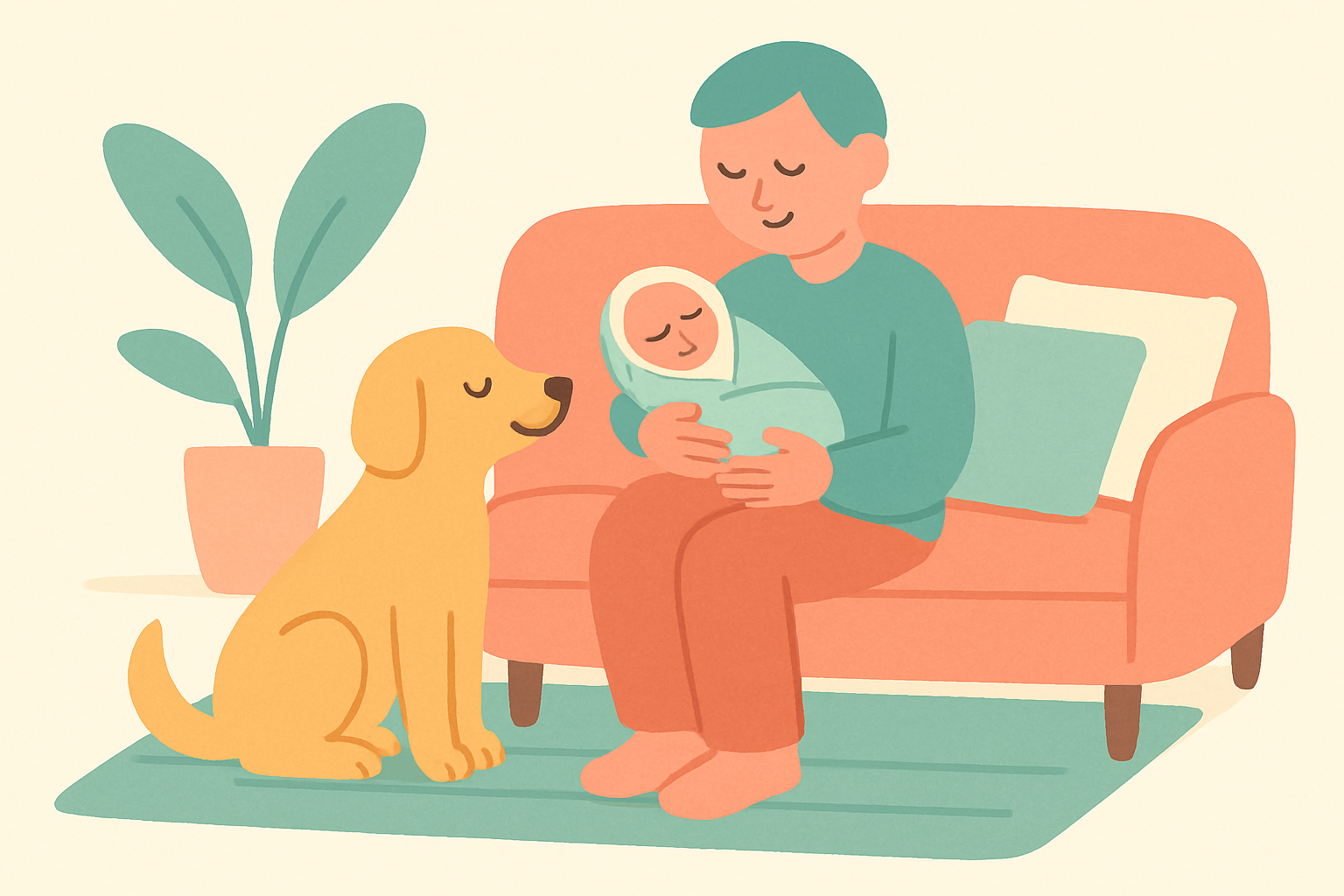
If you have been lying awake wondering how to introduce your dog to a new baby, you are in very good company. For a lot of us, the dog was the first one we brought home and worried over. The thought of that relationship changing, or of the two of them not getting along, can sit heavier than almost anything else on the to do list.
Here is the reassuring part. Most dogs adjust to a new baby just fine, especially when the change is introduced gradually instead of all at once on day one. The goal is not a perfect storybook moment where the dog gazes lovingly at the bassinet. The goal is a dog who finds the baby unremarkable, and a home where everybody has room to breathe.
Below is a calm, practical way to think about the whole process, starting well before the birth and continuing through those first mobile months. Every dog is different and every family is different, so take what fits and leave the rest.

The best introductions are boring ones. If nothing dramatic happens, that means it went well.
Start Preparing Before the Baby Arrives
The single most helpful thing you can do is make the big changes early, while you still have energy and patience to spare. Dogs do not connect a new rule with a new baby. They just notice that life got stricter around the same time a loud small person showed up. If the nursery becomes off limits three months before the birth, it is simply a closed door. If it becomes off limits the day you come home, it feels like a consequence.
Think through what will actually change. Will the dog still sleep in your room? Will walk times shift to whenever someone is free rather than 7am sharp? Will the sofa still be open for jumping on? Whatever the answers, start living those answers now. Many parents find it helps to practice the new schedule for a few weeks so the dog has already stopped expecting the old one.
It is also worth brushing up on a few basic skills, not for obedience trophies but for practical moments. A reliable "go to your bed," a settled down-stay, and walking politely next to a stroller cover most of what you will actually need. If your dog jumps up on people, this is a good season to work on four paws on the floor, since you will often be holding something precious in both arms. A group class or a session with a certified trainer before the birth is time very well spent.
Introduce the Scent First
Dogs make sense of the world through their noses long before their eyes get involved. Giving your dog a preview of the baby's smell means the first in person meeting is only half new. Many families send a swaddle blanket, a hat, or a used onesie home from the hospital a day or two before discharge.
How you present it matters more than the item itself. Rather than waving it in your dog's face or letting the dog treat it as a toy, put it down calmly on the floor or hold it low and let your dog choose to investigate. Sprinkle a few treats nearby. The message you want to send is "this new smell means good things happen," not "this is an exciting object to grab."
You can extend the same idea to sounds and equipment. Some dogs are startled by baby cries, swings, white noise machines, or the sudden appearance of a stroller in the hallway. Playing recorded baby sounds quietly in the background, then gradually raising the volume over a couple of weeks while your dog eats or relaxes, helps take the surprise out of it. If you plan to use a sound machine, our guide to white noise for babies is worth a read for the baby side of that decision too.
The First Meeting, Step by Step
Coming home from the hospital is a big moment for everyone, including the dog who has been wondering where you went. A little choreography goes a long way here.
Before you walk in, make sure someone has taken the dog for a decent walk so the tank of pent up energy is a bit lower. Have the dog on a loose leash held by a calm adult who is not holding the baby. Then let the parent who was away come in first, without the baby, and say a proper hello. That reunion excitement is real and it deserves its own moment, rather than happening while a newborn is in the room.
Once the greeting energy has settled, bring the baby in. Sit down somewhere comfortable, hold the baby securely, and let the dog approach on their own terms. A brief sniff of the feet or the edge of a blanket is plenty for a first hello. Keep faces out of reach. Talk in a normal, easy voice rather than a tense one, because dogs read our nervousness quickly. Then end it early, while the dog is still relaxed, and go back to something ordinary. You are aiming for several short, uneventful meetings rather than one long one.
If your dog seems overwhelmed, that is useful information rather than a failure. Give them space, try again later, and let the pace be theirs. Those first days home are chaotic anyway, and our guide to the first week home with a newborn covers how to keep expectations gentle across the board.
A Rough Timeline of What to Expect
It can help to have a loose map of the process so you know roughly where you are. This is not a schedule to hit precisely, just a common shape that many families recognize.
| Stage | Timing | What tends to help |
|---|---|---|
| Routine changes | 2 to 3 months before birth | New walk times, sleeping spots, and room rules set early |
| Skills practice | 1 to 3 months before birth | Settle on a bed, loose leash next to a stroller, no jumping up |
| Gear and sound preview | 3 to 6 weeks before birth | Set up furniture early, play baby sounds quietly, walk with the empty stroller |
| Scent introduction | 1 to 2 days before coming home | A blanket or hat from the hospital, offered calmly with treats |
| First meeting | Homecoming day | Walk first, greet without the baby, short leashed sniff, end early |
| Settling in | First 2 to 8 weeks | Predictable routine, supervised time together, good things during feeds |
| Mobile baby adjustments | Around 6 to 10 months | Gates, a dog only retreat space, teaching gentle hands |
A general pattern many families experience. Some dogs settle much faster and some need longer, so use this as a guide rather than a deadline.
Daily Life With a Dog and a Newborn
Once the introductions are over, the real work is just consistency. The habit worth building is simple. Let good things happen for your dog while the baby is around. A stuffed chew during feeds, a scratch behind the ears while you rock the bassinet with your foot, a treat tossed when the baby cries. Over time the baby stops being the thing that gets the dog shooed away and becomes the thing that predicts snacks and attention.
Try to protect a small amount of one on one time too, even if it is only ten minutes. It rarely needs to be a long hike. A short sniffy walk, a few minutes of a food puzzle, or a bit of training in the kitchen while dinner cooks gives most dogs the mental engagement they are missing. Some dogs actually cope better with a shorter but more predictable routine than with a longer unpredictable one.
Every dog also deserves a place they can go where nothing will follow them. A crate with the door open, a bed in a quiet corner, or a room behind a gate all work. The rule that makes it effective is that the retreat is genuinely off limits to everyone else, which becomes especially important later. Building this into the flow of your day is easier than it sounds, and pairing it with a loose daily routine with your newborn means both the baby and the dog know roughly what comes next.
Safety wise, the general guidance from veterinarians and child safety organizations is straightforward. Dogs and babies are never left alone together without an adult actively watching, regardless of how trustworthy the dog has always been. Baby gates, playpens, and closed doors are not a judgment on your dog. They are just how you get to relax while you make a coffee.

If your dog growls, that is communication, not defiance. Calmly create space, then talk to a certified trainer or your vet about what happened.
Reading Your Dog's Body Language
Dogs almost always tell us they are uncomfortable long before anything goes wrong. The trouble is that the early signals are quiet and easy to miss when you are running on very little sleep. Learning a handful of them makes a real difference.
Signs that a dog is feeling stressed or unsure include lip licking when no food is around, yawning when they are not tired, turning the head away, showing the whites of the eyes, a tightly closed mouth, a stiff body, or repeatedly leaving the room. None of these mean your dog is dangerous. They mean your dog is asking for a bit of distance, and giving it to them is exactly the right response.
A relaxed dog looks loose. Soft eyes, a wagging tail that moves the whole back end, an open mouth, a willingness to lie down nearby and doze. That is what you are looking for over the first few weeks. If you notice growling, snapping, stiffening over resources, or persistent avoidance, stop trying to work it out alone and reach out to a certified professional dog trainer or a veterinary behaviorist. Early help is far easier than late help, and asking for it is a sign you are doing this well.
When Your Baby Starts Moving
Here is the part that catches many families off guard. The newborn stage is usually the easy part, because the baby stays where you put them. The harder adjustment often comes around the time the baby starts crawling, pulling up, and reaching for things, which is a period our guide on when babies start crawling covers in more detail.
Suddenly your dog is being approached by something unpredictable at eye level, with grabby hands and no sense of personal space. Even patient dogs can find this genuinely stressful. This is when gates and separate spaces stop being optional extras and start being the backbone of a peaceful house. Feeding the dog behind a closed door, keeping chews and toys out of reach during floor time, and having a dog free zone all reduce the number of moments where something could go wrong.
It is also the moment to start teaching gentle hands, long before your baby can really understand. Guiding a small hand into a soft stroke on the dog's back, and calmly stopping ears and tails from being pulled, plants the seed early. Every baby is different in how quickly this lands, and repetition over many months is normal. The dog, meanwhile, should always have an escape route so they never feel cornered into making a choice.
Keep track of the days when everything is new
Between newborn feeds, naps, and a dog who needs a walk, the days blur together fast. Pippy lets you log feeds, sleep, and diapers in a couple of taps, and share the whole picture with your partner so nobody is guessing who did what while the other one was outside with the dog.
Try Pippy Free