
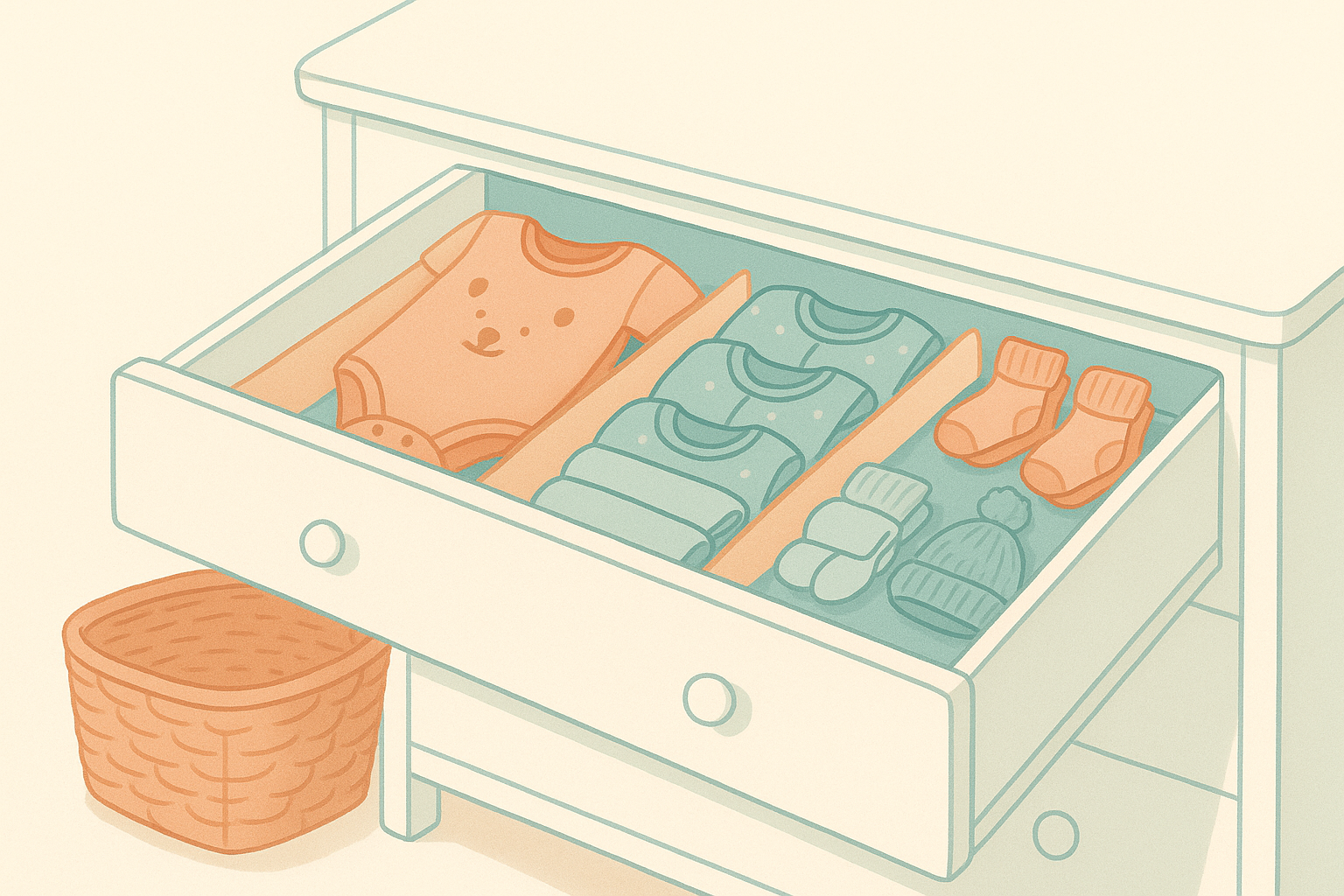
There is a particular kind of new parent moment that goes something like this. It is six in the morning, the baby is crying, the dog is asking to go out, and you are digging through a drawer trying to find a clean onesie that actually still fits. The clothes that fit are mixed in with clothes that are way too small, and somewhere underneath are three outfits with the tags still on that you forgot were even there.
If that sounds familiar, you are not behind. Babies grow fast, sizes overlap in confusing ways, and most of us start out with a delightful mountain of gifts and hand me downs that arrived in no particular order. Learning how to organize baby clothes by size is one of those small, behind the scenes habits that can make your day quietly easier for months.
This guide walks you through a calm, low effort system for sorting, storing, and rotating baby clothes. We will look at dresser and closet setups, how many of each size you actually need, when to size up, what to do with hand me downs, and the gentlest way to deal with the outfits your baby has already outgrown. Every family does this differently, so think of it as a flexible starting point rather than a strict checklist.
- Why Sorting by Size Saves Your Sanity
- Baby Clothing Sizes at a Glance
- The First Sort: Keep, Store, Donate
- Setting Up the Dresser and Closet
- How Many Outfits Do You Actually Need?
- Hand Me Downs Without the Overwhelm
- Signs It Is Time to Size Up
- Storing Outgrown Clothes for the Future
- A Five Minute Monthly Refresh
- Frequently Asked Questions
Hi friend. Before you tackle the whole closet, take a breath. You do not have to do this all in one afternoon. Tiny progress, one size at a time, is more than enough.
Why Sorting by Size Saves Your Sanity
When everything lives together in one big drawer, every diaper change becomes a treasure hunt. You end up reaching for whatever is on top, missing outfits you actually love, and accidentally squeezing your baby into a sleeper that is two sizes too small at three in the morning. Many parents find that sorting by size, even loosely, is the single biggest improvement they make to their nursery setup.
The other thing that happens, especially in the early weeks, is that you simply do not have time to fold laundry into a precise system. A simple structure that holds up when you are tired matters more than a perfect one. If you only have to ask, "Which drawer is this size?" and then drop the clothes in, you will actually maintain it. Anything too fussy tends to fall apart the first time you have two loads of laundry and a fussy newborn at the same time.
Sorting by size also helps you see what you actually own. New babies often arrive with a flood of newborn and 0 to 3 month outfits, and almost nothing in the larger sizes. Once you can see what you have at a glance, it gets much easier to plan ahead, fill the gaps, and not panic when your baby suddenly fits into a size you have nothing for.
Baby Clothing Sizes at a Glance
Baby clothing sizes can be a little chaotic. Different brands use slightly different weight and height ranges, and the age on the tag is usually a rough guide rather than a promise. The size chart below shows the general ranges most major brands follow, but every baby is different, so the fit on your actual baby always wins.
| Size Label | Approximate Weight | Approximate Height | Typical Age |
|---|---|---|---|
| Preemie | Up to 5 lb | Up to 17 in | Born early or small |
| Newborn (NB) | 5 to 8 lb | 17 to 21 in | Birth to about 1 month |
| 0 to 3 months | 8 to 12 lb | 21 to 24 in | About 1 to 3 months |
| 3 to 6 months | 12 to 17 lb | 24 to 26 in | About 3 to 6 months |
| 6 to 9 months | 17 to 21 lb | 26 to 28 in | About 6 to 9 months |
| 9 to 12 months | 21 to 25 lb | 28 to 30 in | About 9 to 12 months |
| 12 to 18 months | 25 to 28 lb | 30 to 32 in | About 12 to 18 months |
Ranges are general guidance and vary by brand. Many babies skip the newborn size entirely, while others stay in 0 to 3 months for several months. Always check the brand's own size chart and how the outfit actually fits your baby.
The First Sort: Keep, Store, Donate
If you are starting from a pile of mixed clothes, the first sort is the most important one. It is also the one many parents put off, because it feels like a big project. The trick is to keep it simple and physical. You only need floor space, a few laundry baskets or large bags, and maybe a friend or partner to keep you company while you do it.
Pull everything out and divide it into three loose categories. The first is what fits your baby right now and the very next size up. This is the keep pile and it is the only pile that lives in the nursery. The second is anything smaller than the current size, plus anything two or more sizes bigger. That becomes your store pile, which goes into labeled bins. The third is anything you know you will not use, whether because of style, gender, season, or condition, and that becomes the donate pile.
Be gentle with yourself about the donate pile. It is easy to feel guilty letting go of gifts, especially anything still new with tags. Many parents find it helps to take a quick photo of the outfit before donating, especially if it was a special gift, so the memory is captured even if the item is not staying. Newborn clothes in particular have a short window, and passing them on to another family who needs them is a kindness, not a betrayal of the giver.
Setting Up the Dresser and Closet
Most nurseries use some mix of a dresser and a closet. The simplest approach is to fold soft basics in drawers and hang anything that wrinkles, anything dressy, and jackets or outerwear. Sleepers, onesies, pajamas, and pants tend to live happily in drawers. Special occasion outfits, cardigans, and coats usually do better on hangers.
Dresser layout that holds up over time
Many parents find that giving each drawer a clear job is what makes the whole system stick. One common setup is a top drawer for the smallest essentials, a middle drawer for the current size of sleepers and onesies, and a lower drawer for the next size up. Drawer dividers, even simple shoeboxes or fabric organizers, are a small purchase that pays off every single day. Sock and hat drawers especially benefit from a divider, because nothing disappears faster than a tiny sock.
If you have a smaller dresser, you may need to combine sizes in a single drawer. In that case, a folded piece of cardboard or a small bin can act as a divider between the current size and the next size up. The goal is not perfection, it is being able to grab the right size in the dark without thinking about it.
Closet organization with size dividers
For hanging clothes, closet size dividers are one of those small items that change everything. They are inexpensive circular or rectangular tabs that clip onto the closet rod and label each section by size. Some parents make them with cardstock and a hole punch. Others buy a set online. Either way, you can spot the right size at a glance, and when laundry comes back, every item has an obvious home.
Keep the current size and the next size up at the front and center of the closet. Push smaller sizes that you are saving for later siblings to the far side, or move them out entirely into storage. Bulky items like jackets and snowsuits often do best at the very ends, where they will not crowd the more frequently used outfits.

If you log diaper changes and outfit swaps in Pippy, you start to notice patterns, like how often you go through sleepers in a week. That makes it much easier to figure out how many of each size you actually need.
How Many Outfits Do You Actually Need?
There is no magic number, and every family lives a little differently, but many parents find that they need fewer outfits per size than they expected once a routine settles in. Laundry catches up faster than you would think, and babies tend to live in two or three favorite sleepers anyway. The biggest exception is the newborn stage, when blowouts, spit up, and middle of the night changes can burn through outfits at a startling pace.
The numbers below are a general starting point. Some babies sail through a size in three weeks and others stretch one size out for months, so adjust as you go. If you find yourself doing laundry every other day just to keep up, that is a signal you might want a few more basics in your current size.
| Item | Newborn Stage | 3 Months and Older |
|---|---|---|
| Sleepers or footed pajamas | 8 to 10 | 6 to 8 |
| Onesies or bodysuits | 8 to 10 | 5 to 7 |
| Pants or leggings | 4 to 6 | 4 to 6 |
| Sweaters or layers | 2 to 3 | 2 to 3 |
| Socks | 6 to 8 pairs | 6 to 8 pairs |
| Hats (weather appropriate) | 2 to 3 | 1 to 2 |
| Outerwear | 1 jacket or bunting | 1 jacket plus rain layer |
Numbers are general suggestions. Your laundry frequency, climate, and whether your baby spits up often will all shift what feels right.
Hand Me Downs Without the Overwhelm
Hand me downs are a gift, but a giant garbage bag of mixed sizes dropped on the front porch can also feel like a small avalanche. The trick is to resist the urge to unpack the whole bag onto the nursery floor at once. Many parents find it much calmer to sort hand me downs one size at a time, ideally a size or two ahead of where the baby is now.
Start by pulling out only the size your baby will grow into next. Wash everything, check for stains or missing snaps in good light, and only keep what is in genuinely good shape and your style. Anything else can go straight to donation, and you do not need to feel guilty about it. The person who gave you the bag wants your baby to be dressed in comfortable clothes, not for you to keep things you will never use.
Once the next size is sorted, store the rest of the bag in a labeled bin somewhere out of the way. You will get to it when you get to it. Some parents schedule a short hand me down session whenever their baby is about a month away from a new size, so the work stays small and the clothes are ready when needed.
Signs It Is Time to Size Up
Babies usually outgrow clothes before the age on the tag suggests, and the change can happen fast. Some babies may stretch out of 0 to 3 month outfits in six weeks, while others stay in newborn sizes for a couple of months. Going by fit rather than age is almost always the gentler choice for everyone.
There are a few common signs that it is time to move to the next size. Snaps that strain to close at the bottom of a sleeper, sleeves that ride up past the wrist, footed pajamas with curled toes inside the foot, pant cuffs that lift above the ankle, and red lines at the wrists, ankles, or thighs after taking an outfit off are all gentle nudges. If the outfit looks like it has shrunk in the wash even though it has not, that is your sign too.
It can also help to keep a couple of outfits from the next size up already washed and waiting. That way, when one of those signs shows up unexpectedly, you have something ready instead of needing to dig through bins. If you track diaper changes and outfit swaps with Pippy, you may notice the moment your current sleeper has stopped working before the next one is even in rotation, which can give you a head start.
Storing Outgrown Clothes for the Future
What you do with outgrown clothes depends on your space, your plans for more children, and what feels right emotionally. Some families pass things straight on, others save everything for a future sibling, and many fall somewhere in the middle. There is no wrong answer here.
If you are saving clothes, start by washing everything and letting it fully dry before storing. Clear plastic bins with snap lids work well, and labeling each bin by size and season makes it much easier to find what you need later. A piece of masking tape with a marker note is enough. Some parents add a small handwritten list of what is inside on top of each bin, so they can scan a stack without unpacking anything.
Keep storage somewhere dry, out of direct sunlight, and away from anywhere that gets damp. Vacuum bags can save room for bulky items like snowsuits, sleeping bags, and winter outerwear, but soft cotton basics usually do best in regular bins so the fabric can breathe a little. Tossing in a cedar block or a fabric safe sachet can help, though strong scents are best avoided around future baby gear.
A Five Minute Monthly Refresh
Once your system is set up, keeping it tidy is mostly about a short, regular check in rather than another big project. Many parents find that a quick five minute refresh once a month, often timed with a diaper restock or a milestone moment, is plenty to keep things working.
The monthly refresh is simple. Open the drawers and the closet and ask three small questions. Is anything in here too small now? Is there anything I am missing in the current size? Is the next size up ready and waiting? Pull anything outgrown straight into a labeled bag or bin, and add anything you need to a running shopping list. That is it.
For families who love a structured approach, our gentle guides on building a daily routine with a newborn and what to pack in a diaper bag pair nicely with the closet refresh. If you are heading back to work or splitting nursery duties, our notes on splitting baby duties with a partner can help make sure the right person is restocking the right size at the right time.
Track Outfits, Sizes, and Everything Else With Pippy
Pippy makes it easy to log diaper changes, sleep, feeds, and notes like outfit changes or growth spurts. Spot the moment your baby is ready for the next size and keep your nursery organized without holding it all in your head.
Try Pippy Free