
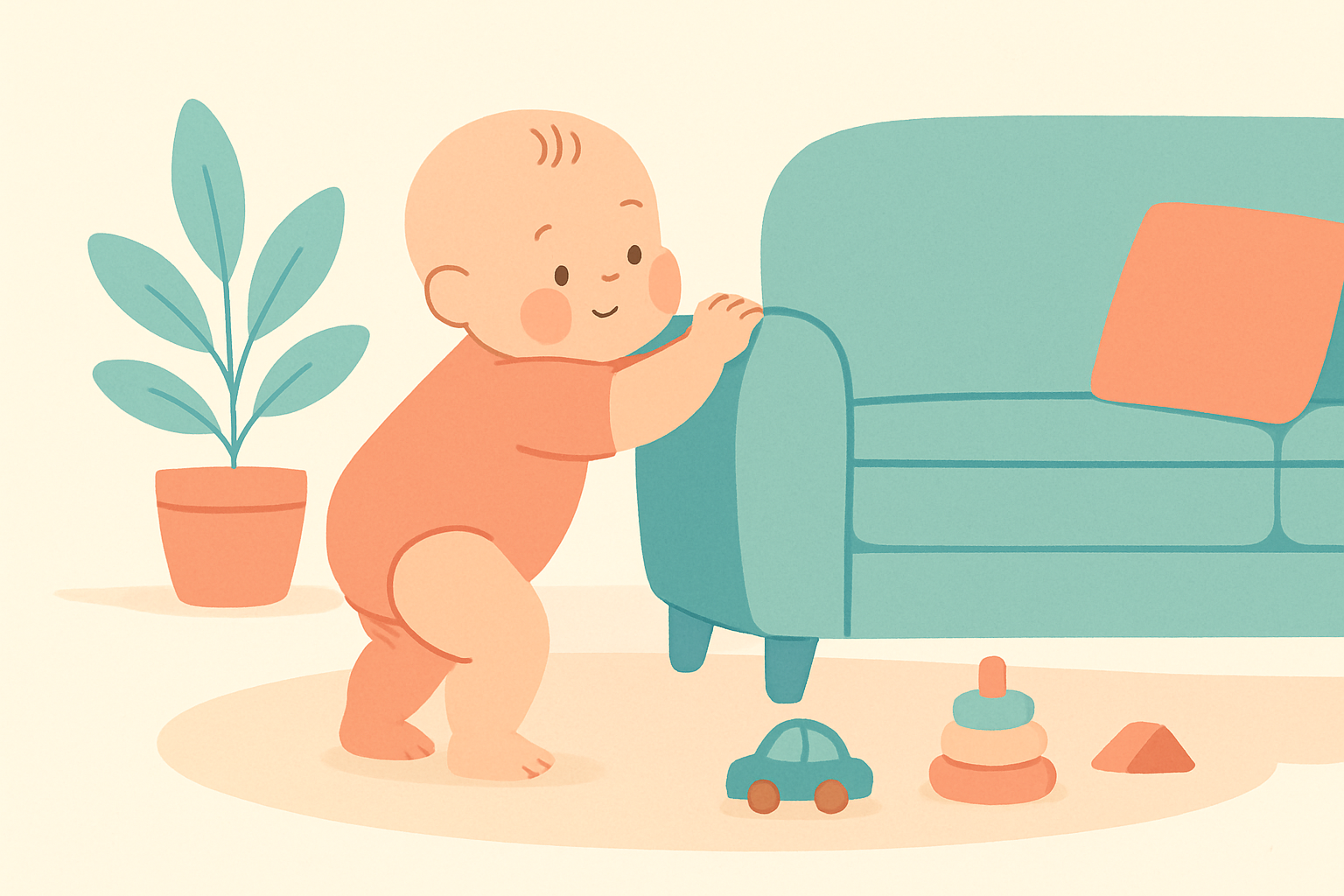
One day your baby is sitting happily on the rug, and the next you turn around to find them gripping the edge of the coffee table, knees shaking, face lit up like they have just discovered gravity has a workaround. It is one of those milestones that arrives with almost no warning, and it changes the shape of your whole house.
So when do babies pull up to stand? Most babies get there somewhere between 8 and 11 months, though plenty start earlier and plenty take a bit longer. It usually follows sitting steadily and pushing up onto hands and knees, and it opens the door to cruising and, eventually, those first wobbly independent steps.
Below we will walk through the typical timing, how the skill builds piece by piece, what tends to come next, and the practical things many parents find worth doing once a baby starts hauling themselves upright on the furniture.

That first pull up is worth a photo, wobbly knees and all. It is the moment the floor stops being the whole world.
When Babies Usually Pull Up to Stand
The commonly cited window for pulling up to stand is roughly 8 to 11 months, with many babies landing around 9 months. Some babies surprise everyone by hauling themselves up at 6 or 7 months, usually strong sitters who have found a conveniently placed couch. Others are still perfectly content on the floor at 11 months and then go from nothing to standing in the space of a week.
What matters more than the exact month is the direction of travel. Babies build gross motor skills in a rough sequence, and each new skill borrows strength and balance from the one before it. A baby who is sitting confidently, rotating to reach toys, and getting up onto hands and knees is building exactly the trunk and hip strength that pulling up requires, even if standing has not happened yet.
It is also worth mentioning that babies born prematurely are usually assessed on adjusted age rather than birth age, which can shift these ranges by a couple of months. Every baby is different, and if your baby's timing feels off to you, your pediatrician can look at the whole picture rather than a single milestone in isolation.
| Skill | Typical age range | What it looks like |
|---|---|---|
| Sitting without support | Around 6 to 8 months | Stays upright, hands free to play, can twist to reach |
| Pushing up onto hands and knees | Around 6 to 9 months | Rocks back and forth, sometimes moves backward first |
| Crawling or scooting | Around 7 to 10 months | Gets across the room somehow, style varies wildly |
| Pulling up to stand | Around 8 to 11 months | Grabs furniture, hauls up to knees then feet |
| Cruising along furniture | Around 9 to 12 months | Sideways steps while holding on with both hands |
| Standing alone briefly | Around 10 to 13 months | Lets go for a few seconds, arms out for balance |
| First independent steps | Around 9 to 15 months | A few steps between two safe landing spots |
These are typical ranges rather than targets or deadlines. Babies move through them at their own pace, and your pediatrician is the best person to weigh in on your baby specifically.
How the Skill Builds, Step by Step
Pulling up looks like one action, but it is really three stacked together. First a baby has to get a grip on something stable. Then they pull their upper body toward it and shift onto their knees. Finally they bring one foot forward, plant it, and push up through that leg into standing. That last piece is the hardest, and it is why so many babies spend a week or two stuck happily in a half kneeling position.
The strength for all of this comes from earlier work. Time on the floor, rolling, reaching across the body, and sitting unsupported all build the core and hip stability that standing depends on. If your baby is still working on the earlier pieces, our guides on when babies sit up and when babies start crawling cover what tends to come first and how to support it gently.
Something many parents find surprising is that not every baby follows the sequence neatly. Some skip crawling entirely and go from sitting to pulling up. Some pull up before they can get themselves back down, which makes for a memorable few weeks. Some cruise for months before letting go. The order shuffles more often than the charts suggest, and a shuffled order on its own is rarely a concern.
Signs Your Baby Is Getting Close
The clearest early hint is weight bearing. If you hold your baby upright with their feet on your lap or the floor and they push down and straighten their legs rather than folding, that is the leg strength piece coming online. Many babies love this game long before they can do it on their own, and doing it for a minute at a time is good practice.
Another common tell is reaching upward. A baby who starts grabbing at the edge of the couch, your knee, or the side of a laundry basket while sitting nearby is testing whether things hold their weight. Around the same time you may notice them getting into a half kneel, one knee down and one foot planted, which is the exact position that pulling up requires.
Frustration is a sign too, oddly enough. A baby who suddenly gets cranky on the floor near furniture is often working on something just out of reach of their current abilities. Many parents find that a burst of fussiness or lighter sleep shows up right before a big motor leap and settles again once the new skill clicks.
What Comes After Pulling Up
Cruising is usually next. Once your baby can stand while holding on, they start taking sideways steps along the couch, the coffee table, or the front of the dishwasher. At first they will keep both hands on the furniture and shuffle. Over time they get bolder, drop to one hand, and eventually make short reaches between two pieces of furniture, which is essentially walking with a safety net.
Somewhere in there most babies learn to lower themselves back down, which is a genuine relief for everyone. Squatting down under control takes more coordination than standing up does, so it often lags by a few weeks. Until then, expect to be summoned to rescue a stranded baby fairly often, including in the middle of the night.
After cruising comes standing without support, then those first steps. The full range for walking is wide, roughly 9 to 15 months, and a baby who cruises confidently at 10 months might still not walk until 14 months. Our guide on when babies walk goes into what typically comes next and how much variation is normal.
Making Pulling Up Safe at Home
Once a baby can pull up, your home essentially becomes a new environment. The safe zone that used to be floor level now extends to about three feet up, and everything within that band is suddenly reachable. Table edges, cords, tablecloths, and anything perched on a low shelf all come into play at once.
The single highest value fix is anchoring furniture. Dressers, bookcases, and TVs can tip when a baby uses them to pull up, and this is one of the genuinely serious hazards of this stage. Wall anchors are inexpensive and widely available. Beyond that, many parents find it helps to clear low surfaces, tuck away cords, and add soft corner covers to the coffee table that has now become the primary climbing apparatus. Our baby proofing checklist walks through this room by room if you want a fuller sweep.
Falls are going to happen, and most of them are small and part of learning. A soft rug or play mat in the area your baby practices most takes the sting out of the majority of them. Barefoot is generally best indoors for balance and grip. And while it is tempting to hover, giving your baby room to wobble, sit down hard, and try again is how the skill actually develops. Being nearby without steadying every attempt is the sweet spot.

Anchor the dressers and bookcases before the pulling up starts, not after. It is a ten minute job that matters more than almost anything else this month.
Pulling Up in the Crib at Night
This one catches nearly everyone off guard. A baby who has just learned to pull up will often practice at 2am, standing at the crib rail, delighted and completely unable to get back down. Sleep gets bumpy for a stretch, and it is one of the more common reasons parents suddenly find themselves back to multiple wakeups after weeks of things going well.
The practical first step is lowering the crib mattress, ideally before your baby is pulling up rather than after. General guidance is to drop it once your baby can push up onto hands and knees, and to move it to the lowest setting once standing begins, so the rail stays high enough to prevent tipping or climbing over. If you are still sorting out sleep space logistics, our post on moving from bassinet to crib covers the transition.
For the standing itself, practice during the day is usually more effective than intervention at night. Helping your baby lower from standing to sitting a few times a day, guiding their hands down and bending their knees, teaches the skill much faster than doing it for them at 3am. When it does happen overnight, many parents find that laying the baby back down calmly, with as little talking and light as possible, and repeating it without fuss works better than a long soothing routine. This phase usually passes within a couple of weeks once the sitting down skill catches up.
See the leaps as they happen
Pippy lets you log milestones like pulling up, cruising, and first steps with a photo and a date, right alongside the sleep and feeding patterns that tend to wobble during a big motor leap, so the whole picture is in one place.
Try Pippy FreeWhen to Check In With Your Pediatrician
Milestone ranges are wide on purpose, and most babies who are a little behind one marker are simply taking their own route. That said, there are a few patterns worth mentioning at a checkup rather than waiting out. Not bearing weight on the legs when held upright by around 12 months, or not attempting to pull up at all by around 12 months, is worth a conversation.
It is also worth raising if your baby consistently uses one side of the body much more than the other, if their legs feel unusually stiff or unusually floppy when you handle them, or if they lose a skill they previously had. Losing a skill in particular is always worth a call rather than a wait and see, even though the explanation is often something ordinary like an illness or a growth spurt.
And if you simply have a nagging feeling that something is different about how your baby moves, that is reason enough. Pediatricians would far rather look at a baby who turns out to be perfectly on track than miss a chance to help early. Bringing a rough sense of what your baby can do, and roughly when each skill showed up, makes that conversation much easier. You can also read more about how Pippy fits into everyday tracking over on our main site.