
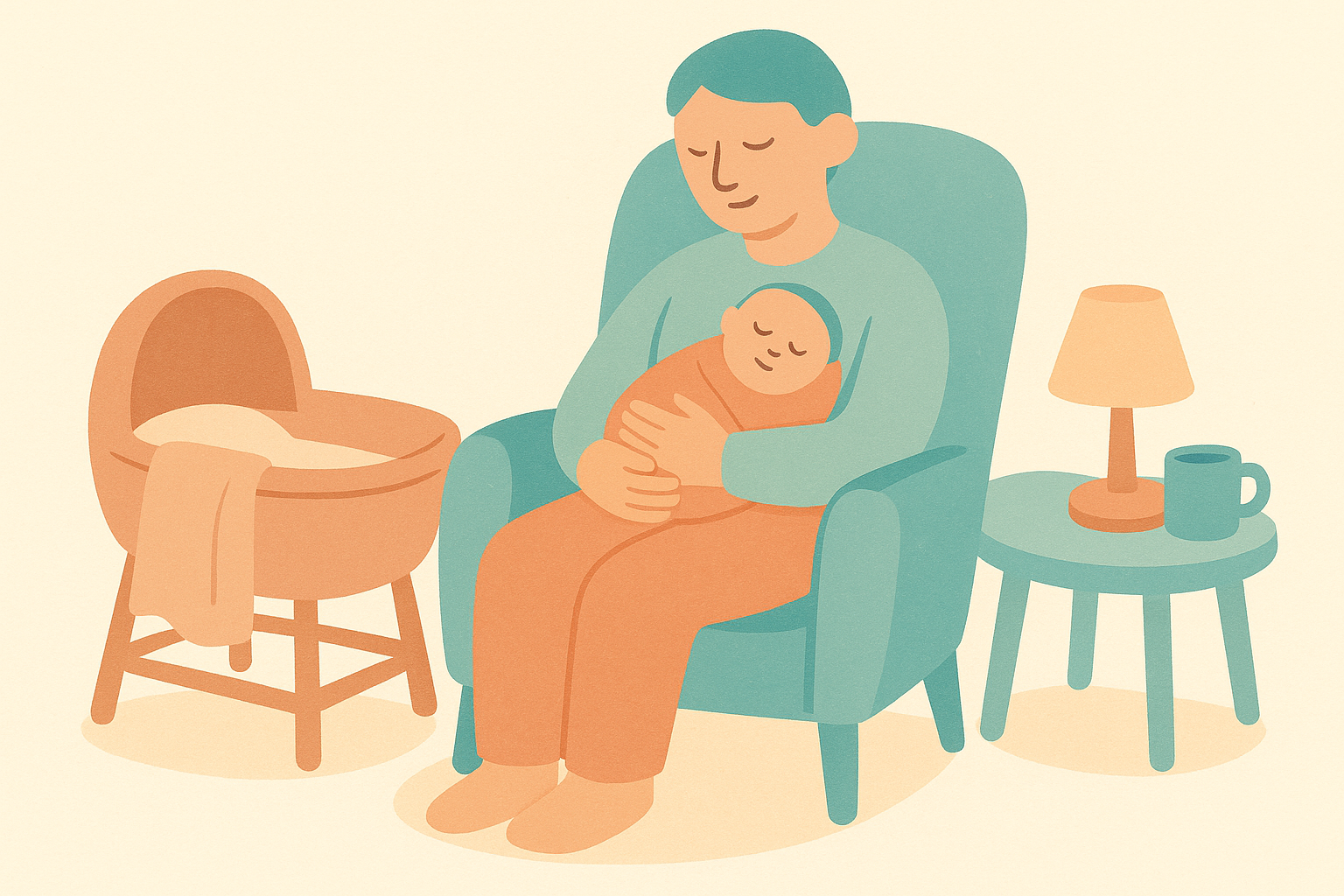
You did everything right. Fed, burped, changed, rocked. Your baby finally goes soft and heavy in your arms, and you hold your breath through the slow, careful lower into the bassinet. Their back touches the mattress and their eyes fly open like a tiny alarm went off. If your baby only sleeps when held, you are in extremely good company, and there is nothing broken about your baby or your parenting.
This is one of the most common newborn sleep patterns there is. It usually is not a habit you accidentally created, and it usually is not permanent either. It is mostly biology, a little bit of physics, and a stage that tends to shift as your baby grows.
Here is what is likely going on, what many parents find helps, how to keep contact naps safe, and when it is worth a call to your pediatrician.

Hi there. If you are reading this one handed with a sleeping baby on your chest, that is exactly the audience I had in mind.
Why Babies Sleep Best on You
For nine months your baby lived somewhere warm, snug, constantly moving, and never quiet. Your heartbeat, your voice, and the sway of your walking were the background of their entire existence. Then they arrive, and we ask them to sleep somewhere flat, still, silent, and cool. From your baby's point of view, your chest is not a preference. It is home.
There is also a practical piece. Newborns have short sleep cycles and spend a lot of that time in lighter, more active sleep, which is why they twitch, grunt, and half wake so easily. In your arms, the small stirrings between cycles often get smoothed over by your warmth and movement before your baby fully surfaces. In a still bassinet, that same stir can turn into a full wake up.
Add in the position change itself. Going from curled against a warm body to flat on a cool mattress triggers a startle response in many young babies, along with a sudden sense that the thing they were touching is gone. Some babies barely notice. Others notice immediately and loudly. Every baby is different, and a baby who protests the transfer is not a baby who is manipulating anyone.
Keeping Contact Naps Safe
Contact naps get a lot of love online, and for good reason, but the safety piece deserves real attention. The general guidance is that holding your baby while you are awake and alert is fine. The risk shows up when the adult falls asleep too, particularly on a sofa, armchair, recliner, or nursing pillow, where a baby can slide into a position that makes breathing difficult.
This matters because exhausted parents fall asleep without planning to. If it is three in the morning and you can feel yourself drifting, the safer move is putting your baby down on their back on a firm, flat, empty surface, even if it means a shorter stretch of sleep for both of you. Our guide to safe sleep guidelines walks through the full picture, including surface, position, and what belongs in the crib.
Some parents find it helps to set up a contact nap deliberately rather than accidentally. That might mean napping on the couch only when another adult is awake and nearby, sitting upright in a firm chair rather than a squishy one, keeping your phone and a drink within reach so you are not tempted to shift, or setting a gentle timer. Talk to your pediatrician about what makes sense for your household and your baby.

If there is a chance you might drift off, the sofa is the riskiest place to be holding your baby. A firm, flat, empty sleep space is the safer landing spot.
Timing the Transfer to the Crib
Most failed transfers are not technique problems. They are timing problems. Babies cycle between lighter and deeper sleep, and a baby who has just drifted off is usually still in the light, easily interrupted stage. Many parents find that waiting until their baby is properly heavy makes a noticeable difference.
The classic signs of deeper sleep that parents watch for are unclenched hands, a loose and slightly open jaw, arms that flop when gently lifted, and slow, even breathing. Depending on the baby, that often takes somewhere in the range of fifteen to twenty minutes after they first close their eyes. Some babies get there faster. Some take longer, and some nights the timing simply does not cooperate.
| What you notice | What it often means | What many parents try |
|---|---|---|
| Eyes closed, hands still curled, quick breathing | Likely still in light sleep | Keep holding a few more minutes |
| Loose jaw, open hands, floppy arm when lifted | Often deeper sleep | A good window to attempt the transfer |
| Startles awake the second the back touches down | Position change or temperature change | Lower bottom first, keep a hand on the chest afterward |
| Sleeps five to ten minutes then wakes crying | Woke between sleep cycles | Pause before rushing in, some babies resettle |
| Wakes every single time, all day, for weeks | Very common in the newborn stage | Alternate contact naps with attempted crib naps |
General patterns many parents notice, not a schedule or a diagnosis. Every baby is different, and your pediatrician is the best source for guidance about your baby.
Mechanics help too. Many parents find that lowering the baby bottom and feet first, keeping the head supported and slightly higher until the very end, and then leaving a warm hand resting on the chest or belly for thirty seconds or so makes the landing feel less like a drop into empty space. Moving slowly and staying quiet through the whole thing beats speed almost every time.
Making the Crib Feel Less Foreign
You cannot make a bassinet feel exactly like a parent, but you can close some of the gap. Temperature is a big one. A mattress that is much cooler than your body is a jarring change, and some parents find that laying a hand on the sheet for a minute beforehand, or simply keeping the room comfortable, helps. Warming the surface with anything left in the crib is not the way to go, since the sleep space should stay empty.
Sound is another lever. A steady, low white noise running through the whole nap can cover the sudden silence that follows being put down, along with household noise that might wake a lightly sleeping baby. Swaddling, for babies who are not yet rolling, can also soften the startle reflex that so often ends a transfer. Our post on when to stop swaddling covers the timing to watch for.
The other thing worth checking is whether your baby is going down overtired. A baby who has been awake too long often fights sleep harder and wakes more easily, which can look a lot like a transfer problem when it is really a timing problem. If that sounds familiar, the signs of an overtired baby are worth a read, and a look at a typical newborn sleep schedule can help you spot where the day is drifting.
When Holding Is Simply the Answer
Some days the transfer is not going to work, and choosing to just hold your baby is a completely reasonable decision rather than a failure. Newborns are not capable of being spoiled, and comfort given now does not create a child who never sleeps alone. If holding your baby is the difference between a rested baby and a miserable afternoon, that is a real and valid trade.
It also helps to know this stage tends to move. Many parents notice things get easier somewhere in the three to five month range as sleep matures and days get more predictable. Plenty of babies still love a contact nap after that, and plenty of parents still love it too. There is no prize for putting your baby down.
What does deserve attention is you. If contact naps mean you never eat, never move, or never sleep, that is worth solving. Trading off with a partner, using naps in a safe carrier while you walk, or protecting one crib nap a day while accepting contact naps for the rest are all ways many families find some breathing room. Splitting the load matters here, and our guide on sharing baby duties with a partner has ideas for making that conversation easier.
When to Check In With Your Pediatrician
A baby who prefers to be held is usually just a baby. Still, there are moments when a quick call is a good idea. If your baby seems genuinely uncomfortable rather than unsettled, arches their back or cries in a pained way when laid flat, spits up in large amounts with distress, or seems to be in a pattern that changed suddenly, your pediatrician can help sort out whether something else is going on.
It is also worth reaching out if your baby is not feeding or gaining as expected, seems unusually difficult to wake, or feels floppy or unwell to you. Trust your read on your own baby. Parents notice things that do not fit long before anyone else does, and no pediatric office minds a question about a newborn.
And please include yourself in that. If exhaustion has reached the point where you are falling asleep in unsafe places, feeling hopeless, or not feeling like yourself, that is a medical topic too, and it is one your provider genuinely wants to hear about. Support exists, and asking for it early is one of the most useful things you can do.
See the pattern behind the naps
When every nap feels random, it helps to see the day laid out. Pippy lets you log naps, wake times, and feeds in seconds, so you can spot how long your baby actually stays awake before the transfers start failing, and share a clear picture at your next pediatrician visit.
Try Pippy FreeFrequently Asked Questions
If the crying that comes after a failed transfer is the hardest part of your day, our guide to soothing a crying baby has more gentle options to try while you wait for this stage to shift.