
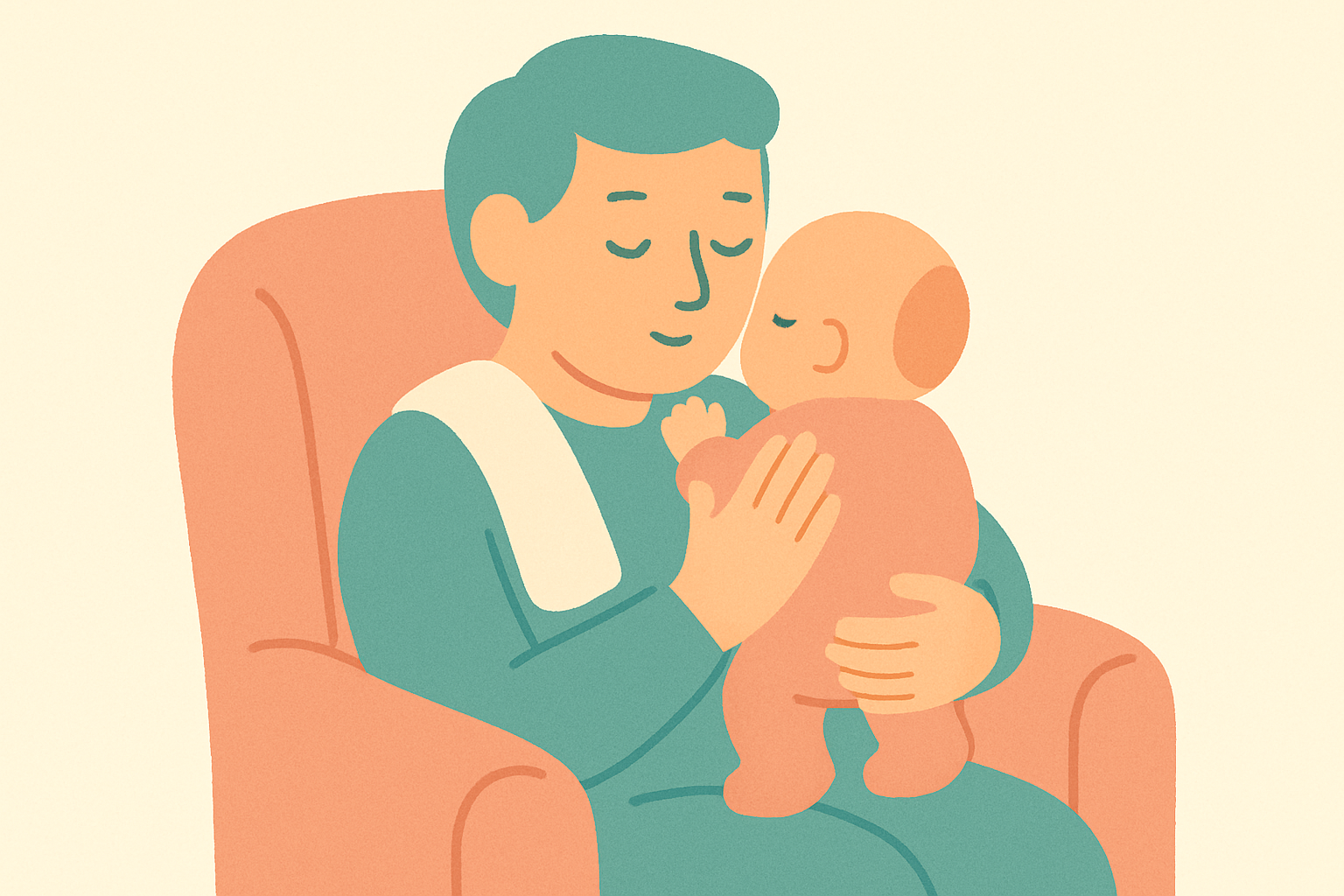
It is 9pm, the house has gone quiet, and you are standing in front of a drawer of tiny clothes trying to solve a problem that feels weirdly high stakes. Too many layers and you worry about overheating. Too few and you picture your baby waking up cold at 3am. Almost every parent has had this exact stare down with a dresser.
The good news is that knowing how to dress baby for sleep gets much simpler once you flip the order of the question. Instead of starting with the outfit, start with the room. Once you know roughly how warm the nursery is, the clothing choice mostly answers itself, and you can stop second guessing it every single night.
Below we will walk through a room temperature chart you can actually use, what TOG ratings on sleep sacks really mean, how to check whether your baby is comfortable, and how all of this shifts for newborns, heat waves, and nights away from home.
- Start With the Room, Not the Outfit
- What to Dress Baby In by Room Temperature
- Understanding TOG Ratings on Sleep Sacks
- How to Tell If Your Baby Is Too Warm or Too Cold
- Dressing Newborns and Babies in a Swaddle
- Hot Nights, Cold Nights, and Nights Away
- When to Check In With Your Pediatrician
- Frequently Asked Questions

A cheap room thermometer next to the crib takes all the guesswork out of this. It is the one nursery gadget many parents say they would buy again.
Start With the Room, Not the Outfit
Babies are not great at regulating their own body temperature in the early months. They have a lot of surface area relative to their size, they cannot kick off a blanket or pull one on, and they cannot tell you they are uncomfortable in any way other than waking up unhappy. That is why the room does so much of the work.
Most pediatricians and safe sleep organizations point to a room somewhere in the range of about 68 to 72 degrees Fahrenheit, which is roughly 20 to 22 degrees Celsius. The everyday version of that guidance is simpler: if the room feels comfortable to you in light clothing, it is probably in a reasonable range for your baby. You do not need to hit a precise number.
What helps far more than chasing a target is actually knowing the number. A small digital thermometer on the dresser costs very little and turns a nightly guess into a two second glance. Many parents find that the nursery runs several degrees warmer or cooler than the rest of the house, especially in a room over a garage, under a roof, or at the end of a long duct run, and they had no idea until they measured it.
What to Dress Baby In by Room Temperature
The common rule of thumb is that a baby needs about one more layer than an adult would want in the same room, counting a sleep sack as a layer. That single sentence covers most nights. The chart below turns it into something you can glance at while half asleep.
A quick note on how to read it: a "layer" here means one piece of clothing covering the torso. A short sleeve bodysuit is one layer, footed pajamas are one layer, and a sleep sack is one layer on top of whatever is underneath. Diapers do not count, and socks are optional in most rooms.
| Room Temperature | What Many Parents Use | Typical Sleep Sack TOG |
|---|---|---|
| Above 75°F (24°C) | Diaper only, or a short sleeve bodysuit | 0.5 TOG or none |
| 73 to 75°F (23 to 24°C) | Short sleeve bodysuit | 0.5 TOG |
| 69 to 72°F (21 to 22°C) | Long sleeve bodysuit or light footed pajamas | 1.0 TOG |
| 65 to 68°F (18 to 20°C) | Footed pajamas, or a bodysuit plus pajamas | 1.5 to 2.5 TOG |
| Below 65°F (18°C) | Long sleeve bodysuit plus footed pajamas | 2.5 TOG |
A general starting point rather than a rule. Fabric weight, how much your baby moves at night, and your own home all shift this, so treat the chart as a first guess and adjust based on how your baby actually feels.
Two things are worth adding. First, fabric matters as much as count. A thin cotton pajama and a thick fleece pajama are both "one layer" but they are not remotely equivalent, so lean toward breathable cotton or bamboo where you can. Second, avoid anything with a hood, loose ties, or a detachable piece that could work its way over your baby's face during the night.
Understanding TOG Ratings on Sleep Sacks
TOG stands for Thermal Overall Grade. It is simply a measure of how much warmth a fabric traps, and it exists so you can compare one sleep sack to another without having to squeeze them both in a shop. A higher number means a warmer sack.
Most brands cluster around a few standard options. Something in the 0.5 TOG range is a light muslin style sack for warm rooms and summer nights. Around 1.0 TOG is the everyday middle option that suits a typical bedroom most of the year. Around 2.5 TOG is a quilted winter weight sack for genuinely cool rooms. Some brands also offer a 1.5 or a 3.5, which is why the chart above gives ranges rather than exact matches.
The part that trips people up is that TOG only describes the sack, never the whole outfit. A 2.5 TOG sack over a bare chested baby is a completely different amount of warmth than the same sack over long sleeve pajamas. So think of the sack as the outer layer and the clothing underneath as the dial you turn. Most sleep sacks print a small suggested clothing guide on the tag, and it is genuinely worth reading once.
Sleep sacks have become the standard answer to warmth partly because loose blankets are not recommended in the sleep space during the first year. If you want the fuller picture on why the sleep space is set up the way it is, our guide to safe sleep guidelines walks through current recommendations in plain language.
How to Tell If Your Baby Is Too Warm or Too Cold
Hands and feet are the least reliable place to check, which is unfortunate because they are the easiest to reach. Babies have immature circulation, and cool hands and slightly cool feet are extremely common even when a baby is perfectly comfortable everywhere else. Many parents add a layer based on cold little toes and end up with a baby who is too warm.
The better check is the back of the neck or the middle of the chest. Slide a hand under the sleep sack and feel the skin. Comfortably warm and dry is what you are looking for. Hot, damp, or sweaty skin suggests too many layers, and it often comes with flushed cheeks, damp hair at the hairline, or faster breathing. Skin that feels genuinely cool across the chest and back, not just the extremities, suggests you could add a layer.
If you find yourself checking constantly, it can help to do one deliberate check at your own bedtime rather than at every stir. Room temperatures usually drop in the small hours, which is why a baby who went down comfortable can wake at 4am needing a little more. Many parents find that noticing this pattern once, and then dressing for the coldest part of the night rather than bedtime, solves a stubborn early morning waking. If you find your nights already have a rhythm you are trying to protect, our post on building a baby bedtime routine pairs well with getting the layers right.
Check the back of the neck, not the hands. Cool little fingers are normal, and they fool almost everyone at least once.
Dressing Newborns and Babies in a Swaddle
Newborns follow the same room first logic, with one adjustment. A swaddle is itself a layer, and often a fairly warm one, so a swaddled newborn usually needs less underneath than the chart above suggests. In a typical room, many parents find a short sleeve or long sleeve bodysuit inside the swaddle is plenty, and they skip the footed pajamas entirely.
Some babies also arrive small or early, and very small babies can lose heat faster than full term newborns. If your baby was premature or low birth weight, your pediatrician or the hospital team may give you specific guidance that differs from general advice, and that guidance should win. It is a reasonable thing to ask about directly at an early visit.
The other shift comes when the swaddle goes away, usually once your baby starts showing signs of rolling. Moving from a snug swaddle to an arms out sleep sack changes how much warmth your baby is holding, so it is worth rechecking the layers for a few nights during that switch. Our guide on when to stop swaddling covers the timing and the transition options in more detail.
Hot Nights, Cold Nights, and Nights Away
Heat waves are the situation parents ask about most, and the honest answer is that above about 75 degrees, a diaper and nothing else is a perfectly reasonable choice. The instinct to put something on a baby is strong, but in a genuinely hot room fewer layers is the safer direction. A fan moving air around the room, aimed at a wall rather than directly at your baby, and blackout curtains closed during the afternoon do more than any clothing choice can. We go deeper on this in our post about keeping baby cool in hot weather.
Cold rooms are usually easier to solve because you have more options. Add a layer underneath before reaching for a heavier sack, keep the crib away from drafty windows and exterior walls, and resist the urge to add a blanket. A space heater, if you use one, should be well away from the crib and ideally on a thermostat rather than running all night at full blast.
Nights away from home are their own category. Hotel rooms, grandparents' houses, and rentals all run at temperatures you cannot predict, and the thermostat is often not under your control. Many parents find it easiest to pack a light sack and a warm sack rather than trying to guess, plus one extra set of pajamas. Getting the first night right in an unfamiliar room is worth the extra space in the bag.
Notice the nights that actually go well
Pippy logs sleep in a few taps and shows you the pattern over days rather than a single rough night, so when you change a sleep sack, drop a layer, or move the crib away from a window, you can actually see whether it helped instead of trying to remember.
Try Pippy FreeWhen to Check In With Your Pediatrician
Most temperature questions are ordinary parenting logistics, but a few are worth a call rather than an internet search. If your baby feels genuinely hot to the touch, seems unusually sleepy or hard to rouse, is breathing faster than usual, or you suspect a fever, contact your pediatrician. In a baby under three months, any fever is treated as something to call about promptly rather than watch.
It is also worth raising if your baby seems consistently sweaty during sleep even in a cool room and light clothing, or if they feel cool and mottled across the chest no matter how you dress them. These are usually explained by something ordinary, but they are exactly the kind of thing a pediatrician would rather look at than have you wonder about at 2am.
And if you have simply been going in circles on layers for weeks and cannot land on something that works, bring it up at a routine visit. A quick conversation about your specific baby, your specific home, and any medical history often resolves in five minutes what a chart cannot. You can read more about how tracking fits into everyday parenting over on our main site.